A Client's Home Office Overlooking a Retention Pond: The Surprising Focus Shift After a Desk Move
A graphic designer couldn't concentrate in her home office. The fix wasn't another productivity app—it was moving her desk to face the water outside her window.
Location
Minneapolis, United States
Property Type
House
Room
Home Office
Direction
North
The Problem
Maya, a 34-year-old graphic designer, had been working from her home office for two years. She complained of constant distraction and a vague sense of unease. 'I can't settle,' she told me. 'I sit down to work and my eyes keep drifting to the wall. I feel boxed in.' Her desk faced a blank beige wall, with the window behind her. She had tried noise-canceling headphones, a standing desk, even rearranging her bookshelf. Nothing helped.
What They Tried
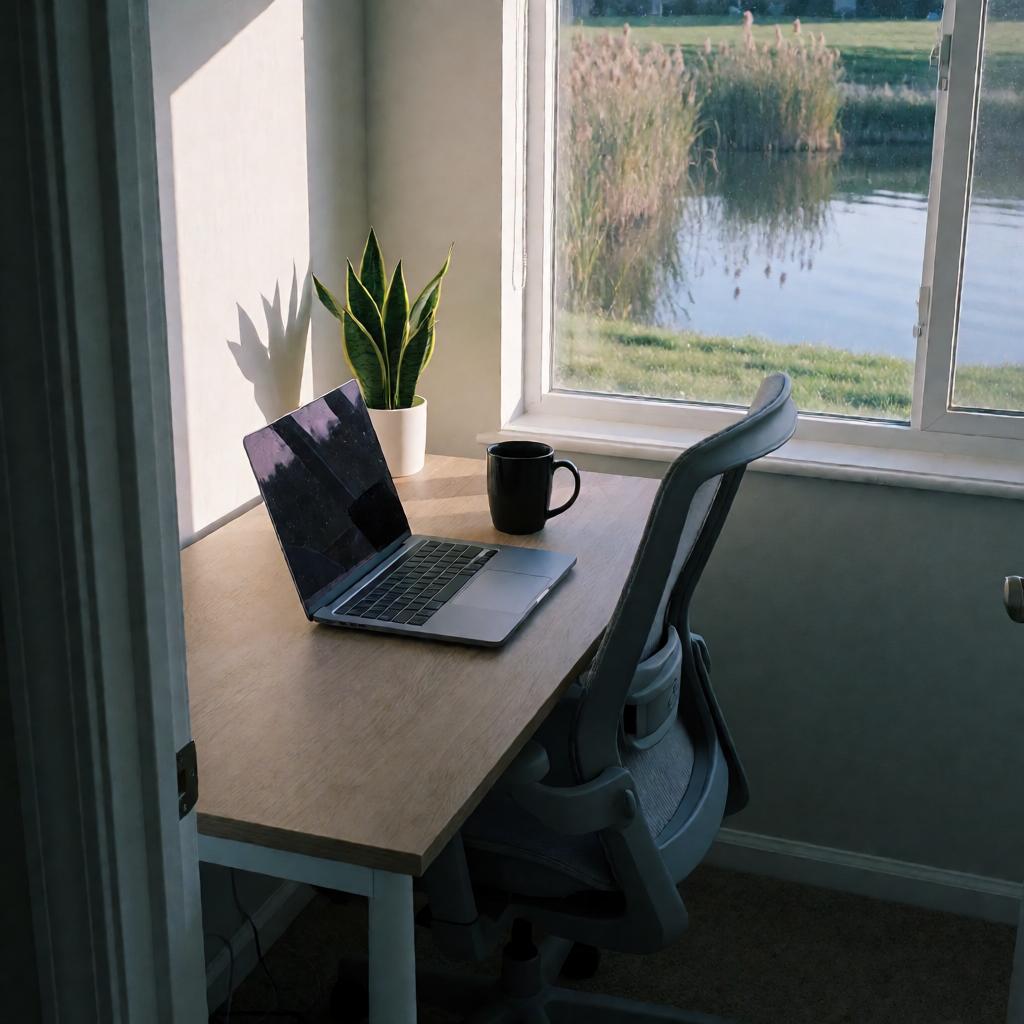
During our consultation, I noticed the room's orientation. The office was on the north side of the house, with a large window looking out onto a small retention pond and a line of reeds. But the desk was pushed against the opposite wall, facing away from the view. Maya had placed it there for the electrical outlet. I suggested she move the desk to face the window, even if it meant running an extension cord. She was skeptical—'Won't the glare be worse?'—but agreed to try it for two weeks.
What Happened
The change was immediate but not magical. Maya reported that within three days, she was able to work for 45-minute stretches without checking her phone. 'It's not that I'm staring at the water,' she said. 'It's that when I look up, I see something that moves—ripples, birds, light changing. It resets my brain instead of making me feel stuck.' She still has distracted days, but the constant low-grade anxiety has faded. She's since added a small plant on the windowsill and says the room feels 'less like a cubicle.'
Spatial Orientation
| Bagua Sector | 坎 ☵ · Kan |
|---|---|
| Direction | North |
| Element | water |
What works best here
Kan (1) · Water. North side can be slightly taller than South for a grounded feel.
Place: dark-colored ceramics, stone objects, heavy bookshelves.
Recommended crystal
Black Obsidian or Smoky Quartz — placed on a low table or shelf in the north corner
A solid, weighty presence here helps the room feel anchored and secure
Source Analysis
1. The Original Principle
Original Chinese
若居山谷,最怕凹风;若在平洋,先须得水。
English Translation
An old manual on dwellings advises: if building on flat land, seek proximity to water. The principle holds that a water source provides both practical and psychological benefit—a living, moving element that balances a static environment.
2. About the Source
雪心赋 论阳宅 by Bu Yingtian · China · Tang Dynasty (618–907 CE)
The Snow Heart Rhapsody is a poetic yet rigorously analytical classical text on landscape assessment. Written in rhymed prose, it covers mountain forms, water patterns, terrain energy, and site selection with remarkable literary elegance. Its observations about how land contours create sheltered, comfortable settings for human habitation remain relevant to modern site planning and environmental psychology.
3. How This Principle Applies to This Case
The classical text observes that dwellings on flat plains benefit from being near water. In this case, the client's home office overlooked a retention pond but the desk faced away. By repositioning the desk to face the water, the client gained a dynamic visual anchor. Modern environmental psychology supports this: natural scenes with movement (water, foliage) restore directed attention and reduce mental fatigue. The principle isn't mystical—it's about aligning a workspace with a restorative view.
Bring the Purest Energy Into Your Home
Sourced from altitudes above 4,000 meters in the Himalayan range — the highest place on Earth and the closest to the sun. These crystals formed over millions of years in some of the planet's most pristine conditions, untouched by industrial pollution. Each piece carries the raw, unfiltered energy of the mountains. Whether placed on a nightstand, a desk, or a meditation corner, they serve as a quiet anchor — a daily reminder to pause, breathe, and reconnect.
Explore the HIMA ALAÏA collection →Case source
The Inspired Office
One of the few US consultancies specializing exclusively in office and commercial Feng Shui design. Deep expertise in home office Feng Shui, document management, and workflow decluttering.