I Fixed the Damp, Musty Smell in My Basement Bedroom by Doing One Thing (Not a Dehumidifier)
A renter discovers that the constant dampness and poor sleep in her below-grade bedroom might have less to do with humidity and more to do with what was happening right outside her window.
Location
Chicago, United States
Property Type
Apartment
Room
Bedroom
Direction
North
The Problem
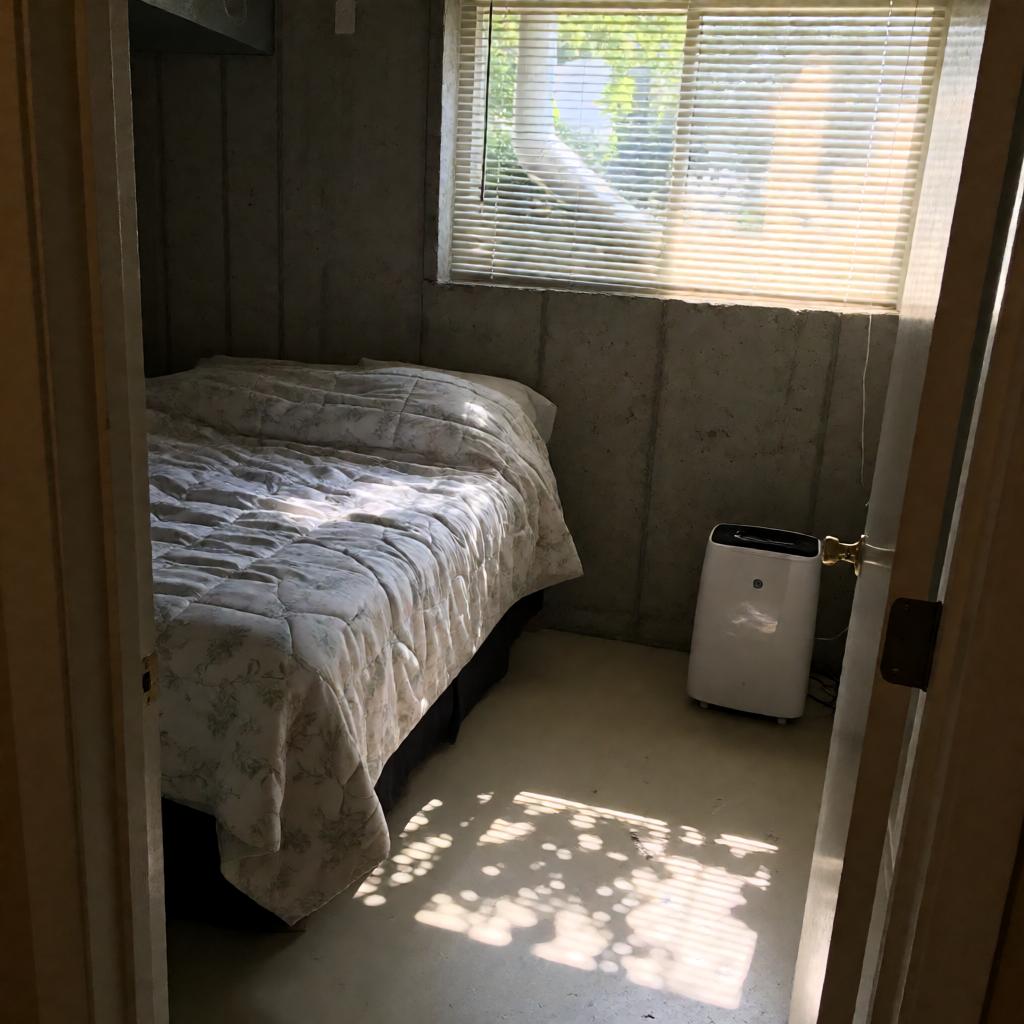
I live in a basement apartment. It's cheap, it's close to the subway, and it has exactly one window. That window looks out onto a concrete retaining wall and a tiny, perpetually wet strip of dirt where the building's downspout empties out. For the entire first year, my bedroom smelled like a wet basement—musty, heavy, gross. My sheets felt damp even when they were clean. I was waking up with headaches and a stuffy nose almost every morning. I bought a $200 dehumidifier. I ran it constantly. It helped a little, but the smell always came back. I tried those charcoal bags. I tried cracking the window. Nothing really worked. I started to think I just had to live with it.
What They Tried
A friend who does landscaping came over for dinner and immediately clocked the problem. She pointed at the downspout outside my window. 'That's dumping water right at your foundation,' she said. 'And the ground here slopes toward the house, not away from it.' She explained that water was pooling in that low strip of dirt and seeping through the concrete. The fix wasn't complicated. I bought a cheap plastic downspout extension—like $12 at the hardware store—and attached it so the water drains five feet away from the building. Then I dug a shallow trench along the outside wall and filled it with gravel to encourage drainage. Finally, I pulled my bed about a foot away from the exterior wall so air could circulate behind it. That was it. No major construction. No landlord involvement. Just redirecting water and giving the wall some breathing room.
What Happened
The change was not instant, but within about ten days, the musty smell in my bedroom was basically gone. The dehumidifier now collects way less water. My sheets feel dry. I still get the occasional stuffy morning if I forget to run the fan, but the constant dampness and headaches are gone. I slept through the night for the first time in months last week. I'm not saying it's a miracle cure—it's a basement, it's always going to be a basement—but the difference is real and measurable.
Spatial Orientation
| Bagua Sector | 坎 ☵ · Kan |
|---|---|
| Direction | North |
| Element | water |
What works best here
Kan (1) · Water. North side can be slightly taller than South for a grounded feel.
Place: dark-colored ceramics, stone objects, heavy bookshelves.
Recommended crystal
Black Obsidian or Smoky Quartz — placed on a low table or shelf in the north corner
A solid, weighty presence here helps the room feel anchored and secure
Source Analysis
1. The Original Principle
Original Chinese
地卑处切忌泉流。
English Translation
A classical text on dwelling places warns against building or sleeping in low-lying areas where springs or water collect. Such sites were considered unfavorable because of persistent dampness and poor drainage. The recommended remedy was to raise the ground or redirect the water away from the structure.
2. About the Source
雪心赋 论龙穴真假 by Bu Yingtian · China · Tang Dynasty (618–907 CE)
The Snow Heart Rhapsody is a poetic yet rigorously analytical classical text on landscape assessment. Written in rhymed prose, it covers mountain forms, water patterns, terrain energy, and site selection with remarkable literary elegance. Its observations about how land contours create sheltered, comfortable settings for human habitation remain relevant to modern site planning and environmental psychology.
3. How This Principle Applies to This Case
The classical principle warns against low-lying sites where water naturally gathers, because dampness undermines both the structure and the health of those inside. In this case, the narrator's basement bedroom sat at the lowest point of the property, and a downspout emptied directly against the foundation. The mechanism is straightforward: water seeped through concrete, raising indoor humidity, which encouraged mold and dust mites—common triggers for headaches and congestion. By extending the downspout and improving drainage, she redirected water away from the building, reducing moisture at the source rather than just treating the symptom. Modern building science confirms that exterior water management is the first line of defense against basement dampness. The classical observation about low-lying land and water flow aligns closely with this practical approach.
Bring the Purest Energy Into Your Home
Sourced from altitudes above 4,000 meters in the Himalayan range — the highest place on Earth and the closest to the sun. These crystals formed over millions of years in some of the planet's most pristine conditions, untouched by industrial pollution. Each piece carries the raw, unfiltered energy of the mountains. Whether placed on a nightstand, a desk, or a meditation corner, they serve as a quiet anchor — a daily reminder to pause, breathe, and reconnect.
Explore the HIMA ALAÏA collection →Case source
Nicolette Vajtay
Feng Shui consultant helping clients transform their homes through intentional spatial design.