I Lowered My Front Door Awning 40cm — And My Constant Neck Pain Finally Eased
A homeowner notices chronic neck pain and daily stress ease after adjusting an oversized front entry structure that loomed over the door.
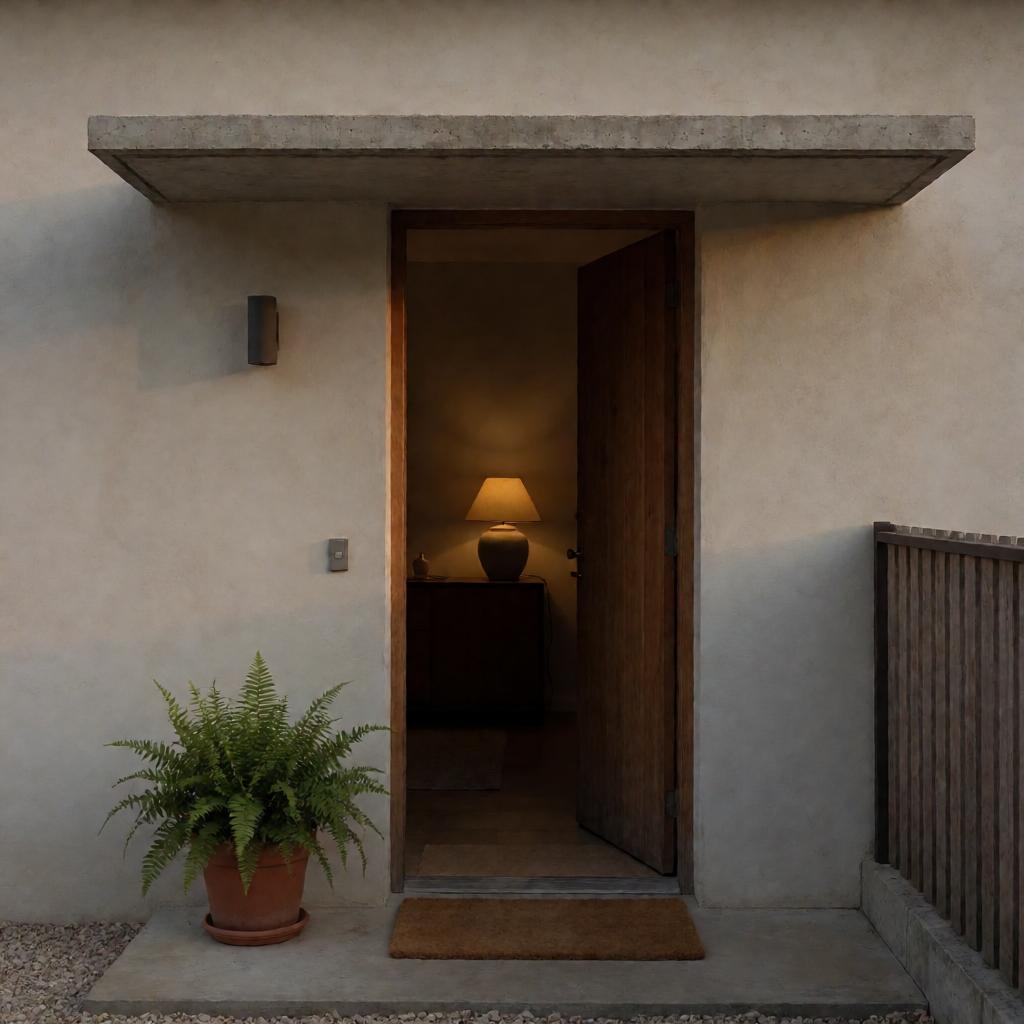
Location
Portland, Oregon, United States
Property Type
House
Room
Entryway
Direction
Northwest
The Problem
For two years I lived with a dull, persistent ache at the base of my skull. It wasn't dramatic — no shooting pains, no numbness. Just a low-grade tension that started around 3pm and settled in for the evening. I blamed my desk setup, then my pillow, then my phone. I bought an ergonomic chair. I tried a cervical traction device I saw on YouTube. Nothing stuck. The thing I kept coming back to, without wanting to admit it, was my front door. The house came with a heavy concrete awning jutting out over the entry — massive, dark, maybe 2.5 meters above the threshold. Every time I walked up the path, something in my shoulders tightened. I felt small under it. I dismissed this as a weird quirk for months.
What They Tried
I finally brought it up with a designer friend who does residential work. She came over, stood on the sidewalk, and just looked at the entry for a full minute. Then she said: 'That thing is doing something to you.' We measured it. The awning was 2.4 meters high and projected 1.8 meters out — way out of proportion to the 0.9-meter-wide door. Her suggestion was simple: lower it. Not remove it, just bring it down to a normal residential height, roughly 2 meters, and reduce the projection to about 1 meter. The contractor did it in a day and a half. The new structure is lighter, shallower, and sits flat against the facade. From the street, the door now reads as the focal point, not the shadow above it.
What Happened
The neck pain didn't vanish overnight. I want to be honest about that. But within about three weeks, I noticed I wasn't reaching for ibuprofen at 4pm anymore. The tension at the base of my skull faded from a daily companion to an occasional visitor. What surprised me more was the psychological shift. Walking up to my own front door stopped feeling like approaching something that was pressing down on me. I hadn't realized how much low-level dread I carried just entering my own home. My partner said I seemed less irritable in the evenings. I don't have a lab coat, and I can't prove the awning was the cause. But the timing lines up, and I'm not going to argue with it.
Spatial Orientation
| Bagua Sector | 乾 ☰ · Qian |
|---|---|
| Direction | Northwest |
| Element | metal |
What works best here
Qian (6) · Metal. Northwest should feel open, organized, and uncluttered.
Place: clean-lined storage, metal objects, minimal decor, organized shelving.
Recommended crystal
Clear Quartz or Hematite — placed on a desk or shelf where it stays dust-free and visible
This sector supports clarity and order — keep it clean and intentional, not crowded
Source Analysis
1. The Original Principle
Original Chinese
天门阳首,宜平稳实,不宜绝高壮,犯之损家长,大病头项等灾。
English Translation
The main gate of a home is regarded as the 'heavenly door' — the head of the household's active, outward-facing principle. It should be steady and grounded, not towering or oppressive. An excessively tall or looming entry was understood to affect the head of the household, particularly the head and neck. The remedy was to bring the structure back to human scale — stable, solid, proportionate.
2. About the Source
宅经 by Attributed to the Yellow Emperor · China · Tang Dynasty (618–907 CE), based on earlier traditions
The Classic of Dwellings is one of the earliest surviving Chinese texts dedicated entirely to residential architecture. It presents a holistic view of the home as a living organism — comparing the house to a body with its own anatomy of walls, doors, rooms, and courtyards. Its core teaching is that a well-arranged home supports the health and fortune of its inhabitants as naturally as good soil supports healthy plants.
3. How This Principle Applies to This Case
This case illustrates a straightforward spatial principle: the entry structure sets the body's first physical and psychological relationship with the home. An oversized overhead element — in this case a 2.4-meter awning projecting nearly twice the door's width — creates a compression effect. You physically duck, even slightly, before entering your own space. Over hundreds of repetitions, that micro-adjustment accumulates as tension in the neck and shoulders. The classical observation that an overly imposing 'heavenly door' harms the household head maps onto what modern environmental psychology calls 'ceiling height effect' — low or looming overhead structures reliably trigger subconscious stress responses. The fix isn't mystical. It's proportional. Bring the structure back to human scale, and the body stops bracing.
Bring the Purest Energy Into Your Home
Sourced from altitudes above 4,000 meters in the Himalayan range — the highest place on Earth and the closest to the sun. These crystals formed over millions of years in some of the planet's most pristine conditions, untouched by industrial pollution. Each piece carries the raw, unfiltered energy of the mountains. Whether placed on a nightstand, a desk, or a meditation corner, they serve as a quiet anchor — a daily reminder to pause, breathe, and reconnect.
Explore the HIMA ALAÏA collection →Case source
Nicolette Vajtay
Feng Shui consultant helping clients transform their homes through intentional spatial design.