I Moved My Desk 6 Feet and My Home Office Finally Feels Like a Place I Can Think
A designer rearranges a client's home office desk away from the door and into a command position, resulting in better focus and less anxiety.
Location
Portland, Oregon, United States
Property Type
House
Room
Home Office
Direction
Southeast
The Problem
My client — let's call her Dana — had a home office that she described as 'the room where motivation goes to die.' She'd sit down to work and within ten minutes she'd be checking her phone, getting up for snacks, or just staring at the wall. She blamed herself. Said she had no discipline. But the room itself was the problem. Her desk faced a blank wall, with her back to the door. Every time her partner walked past in the hallway, she'd flinch. She didn't even realize she was doing it.
What They Tried
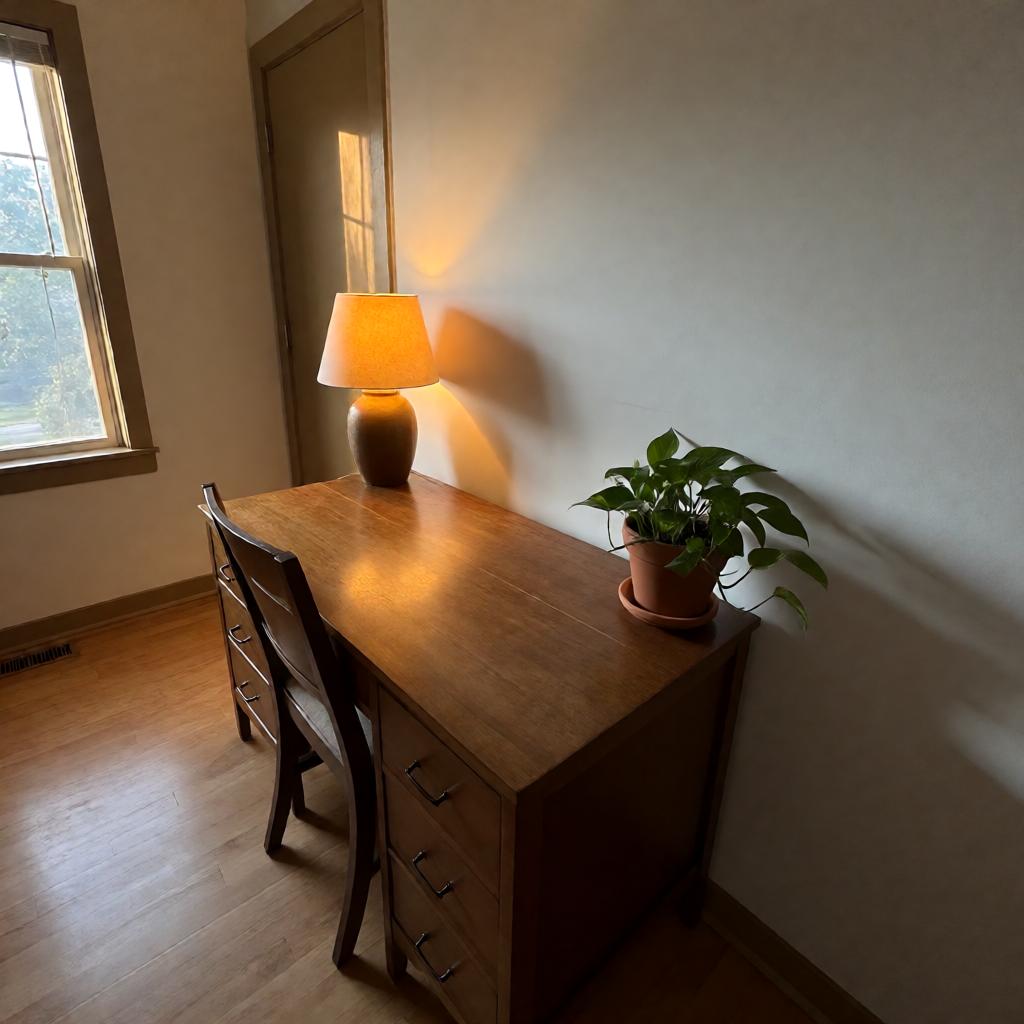
I asked her to move the desk. Not buy a new one — just move it. We shifted it about six feet to the right, so it now sits diagonally in the corner, facing the door but not directly in line with it. Her back is to a solid wall. She can see who's coming. I also removed a large mirror that was reflecting the hallway light directly onto her screen — that was causing glare she'd been squinting through for months without noticing. We added a small plant on the corner of the desk and a warm lamp on the opposite side.
What Happened
Dana texted me two weeks later. She said she'd finished a project she'd been avoiding for a month. She wasn't sure if it was the desk or just a good week, but she'd stopped flinching when her partner walked by. She also said she'd stopped snacking at her desk, which she hadn't even mentioned as a problem. I'll take it.
Spatial Orientation
| Bagua Sector | 巽 ☴ · Xun |
|---|---|
| Direction | Southeast |
| Element | wood |
What works best here
Xun (4) · Wood. Southeast loves moderate height with an airy, open feel.
Place: tall leafy plants, natural fiber rugs, light wood tones, cream and soft green.
Recommended crystal
Citrine or Green Jade — placed on a wooden side table in the southeast corner
Perfect for a creative workspace or journaling spot; natural light is your friend here
Source Analysis
1. The Original Principle
Original Chinese
生气贪狼属木上吉延年武曲属金上吉 天医巨门属土中吉伏位辅弼属木小吉 绝命破军属金大凶五鬼廉贞属火大凶 祸害禄存属土次凶六煞文曲属水次凶
English Translation
An eighteenth-century manual on residential layout maps eight directions to eight influences. The 'Sheng Qi' direction, associated with growth, is considered most favorable; 'Yan Nian,' associated with stability, is also favorable. 'Jue Ming' and 'Wu Gui' are considered unfavorable. The recommendation is to place important furniture — desks, beds, stoves — in favorable positions and avoid unfavorable ones.
2. About the Source
八宅明镜上卷 by Yang Yunsong (attributed) · China · Qing Dynasty (1644–1912 CE)
The Eight Mansions Bright Mirror is one of the most influential classical Chinese texts on residential architecture. For over three centuries, it has served as a foundational reference for understanding how the layout and orientation of living spaces affect the wellbeing of their inhabitants, focusing on how living spaces can be arranged to support health, relationships, and prosperity.
3. How This Principle Applies to This Case
The classical text identifies certain spatial orientations as supportive and others as draining. In this case, the desk faced a wall with the occupant's back to the door — a configuration that modern environmental psychology calls 'low prospect, low refuge.' The brain stays in a mild threat-detection mode when it can't see entrances. Moving the desk to a position with a clear sightline to the door and a solid wall behind it reduced that background vigilance, freeing cognitive resources for actual work. The text's 'favorable direction' concept aligns with what we now call a command position: visible entry, protected rear.
Bring the Purest Energy Into Your Home
Sourced from altitudes above 4,000 meters in the Himalayan range — the highest place on Earth and the closest to the sun. These crystals formed over millions of years in some of the planet's most pristine conditions, untouched by industrial pollution. Each piece carries the raw, unfiltered energy of the mountains. Whether placed on a nightstand, a desk, or a meditation corner, they serve as a quiet anchor — a daily reminder to pause, breathe, and reconnect.
Explore the HIMA ALAÏA collection →Case source
Dana
Modern Feng Shui content creator sharing practical spatial tips for everyday life.