I Moved My Desk From the Corner Under the Stairs—Here's What It Did to My Workday
A small change in my home office—moving my desk out of a cramped corner—quietly fixed my focus problems.
Location
Portland, OR, United States
Property Type
House
Room
Home Office
Direction
South
The Problem
I work from home three days a week, and my 'office' is basically a landing at the top of the stairs. I’d shoved my desk into the corner because it fit. For months, I felt tired by 10 AM. My eyes watered. I’d snap at my husband over nothing. Honestly, I thought I needed a vacation.
What They Tried
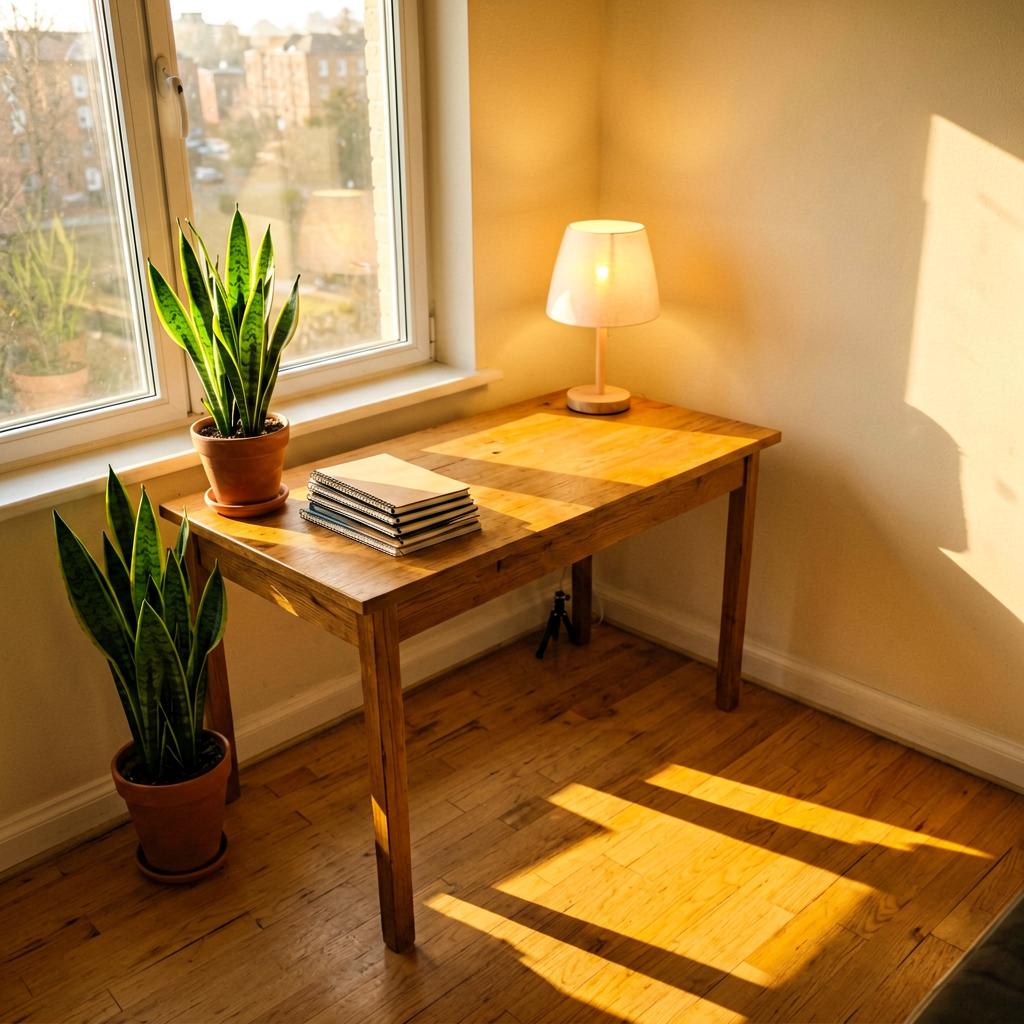
My friend came over and said, 'You need to move your desk.' I laughed. But then I looked at the corner—it was dark, even with the lamp on. So I moved the desk to the opposite wall, facing the window. I also cleared the clutter off the shelf above it. Took maybe twenty minutes.
What Happened
Within a week, I noticed I wasn’t dreading my afternoon calls. My eyes stopped watering by noon. I didn’t feel that weird heavy fog after lunch. I’m not saying it’s magic—but I haven’t snapped at my husband in two weeks. That’s a record.
Spatial Orientation
| Bagua Sector | 离 ☲ · Li |
|---|---|
| Direction | South |
| Element | fire |
What works best here
Li (9) · Fire. South should feel more open and lower than North for visual balance.
Place: low-profile furniture, mirrors, glass surfaces, warm lighting.
Recommended crystal
Clear Quartz or Sunstone — placed where it catches natural light, like a windowsill or console table
Mirrors work exceptionally well here — they reflect light and make the room feel larger
Source Analysis
1. The Original Principle
Original Chinese
子为死丧超级大国右手,长子妇命座,犯之害命坐人,失魂伤目、水灾口舌。[修已壬同]
English Translation
This passage from an old Chinese text on dwellings lists taboos for placing a married woman’s seat. It warns that putting her seat in the position tied to death or mourning could harm her—causing low spirits, eye problems, floods, or arguments. It suggests aligning with a certain day cycle as a fix.
2. About the Source
宅经 by Attributed to the Yellow Emperor · China · Tang Dynasty (618–907 CE), based on earlier traditions
The Classic of Dwellings is one of the earliest surviving Chinese texts dedicated entirely to residential architecture. It presents a holistic view of the home as a living organism — comparing the house to a body with its own anatomy of walls, doors, rooms, and courtyards. Its core teaching is that a well-arranged home supports the health and fortune of its inhabitants as naturally as good soil supports healthy plants.
3. How This Principle Applies to This Case
The classical text observes that a seat placed in a 'death' position—often a dark, cramped, or overlooked corner—correlates with fatigue, eye strain, and irritability. Modern psychology explains this as spatial influence on mood and cognition: poor sightlines, lack of natural light, and a cramped visual field increase cognitive load and stress hormones. Moving the desk to face a window and opening up the space reduced visual clutter, improving focus and emotional regulation. The case shows that a simple positional change, grounded in observation, can have measurable psychological effects—no mysticism required.
Bring the Purest Energy Into Your Home
Sourced from altitudes above 4,000 meters in the Himalayan range — the highest place on Earth and the closest to the sun. These crystals formed over millions of years in some of the planet's most pristine conditions, untouched by industrial pollution. Each piece carries the raw, unfiltered energy of the mountains. Whether placed on a nightstand, a desk, or a meditation corner, they serve as a quiet anchor — a daily reminder to pause, breathe, and reconnect.
Explore the HIMA ALAÏA collection →Case source
The Simple Home Project
Founded by Tina Robinson, former NYC fashion executive turned BTB Feng Shui practitioner. Focuses on minimalism, space decluttering, and home harmony design.