I Moved My Desk to Face the Tall Pine Tree Outside My Window — And My Writer's Block Disappeared
A freelance writer rearranges her home office after a friend points out a simple pattern: she couldn't see any trees from her desk. Three weeks later, she's writing more and worrying less. Here's what actually changed.
Location
Portland, Oregon, United States
Property Type
Apartment
Room
Home Office
Direction
East
The Problem
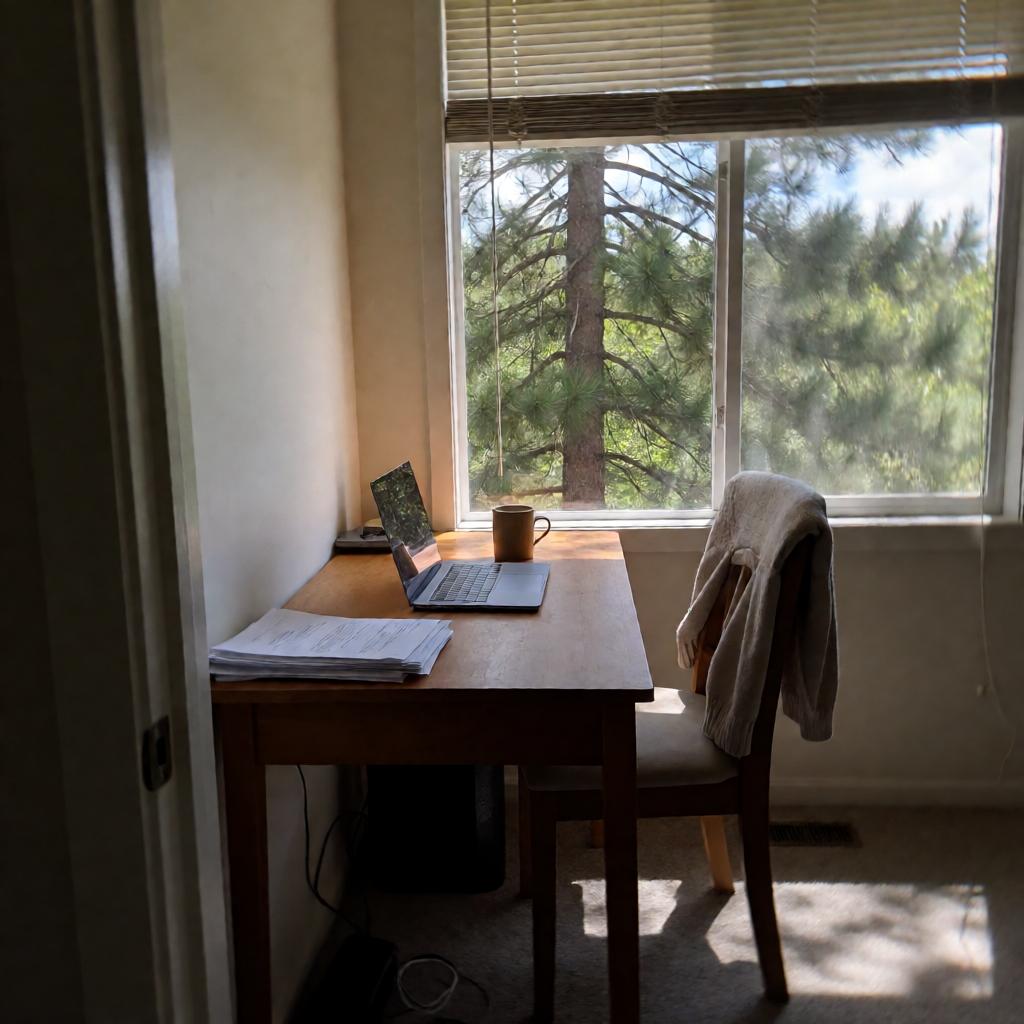
I'd been stuck for months. Not just creatively — my whole workday felt like pushing through wet sand. I'd sit at my desk in the corner of my apartment, staring at a blank wall, and wonder why I ever thought I could make a living writing. My friend Maya came over for coffee one Saturday and said, 'Where's your window? Why are you facing a wall?' I realized I hadn't opened the blinds in weeks. The desk was shoved into the darkest corner of the room — I'd put it there because the outlet was convenient. It never occurred to me that I was basically working in a closet.
What They Tried
Maya suggested I try moving the desk to face the window. Not against the wall — facing it. I was skeptical. It felt like feng shui nonsense or something. But I was desperate enough to try anything. I moved the desk so it sat perpendicular to the window, giving me a clear view of the tall pine tree outside. I removed the pile of books and papers that had been blocking the windowsill. I opened the blinds. Then I sat down and waited to feel inspired. Nothing magical happened, to be honest. But over the next week, I noticed I was reaching for my notebook more often. The tree had birds in it. Squirrels. The light changed throughout the day. I started looking up from my screen instead of at the wall.
What Happened
It's been about three weeks. I won't pretend I've written a novel. But I've finished four articles I'd been avoiding for months. The bigger change is mental — I don't dread sitting down anymore. My friend Maya says it's just because I can see outside. Maybe. But I think there's something about having that tall, quiet tree in my line of sight that makes the work feel less like a cage. I also sleep better, oddly enough. I think it's because I'm not stewing in frustration all day.
Spatial Orientation
| Bagua Sector | 震 ☳ · Zhen |
|---|---|
| Direction | East |
| Element | wood |
What works best here
Zhen (3) · Wood. East should be the tallest area of the room when possible.
Place: tall plants (especially bamboo or fiddle-leaf fig), wooden furniture, green accents.
Recommended crystal
Green Aventurine or Moss Agate — placed near a window or on a plant shelf in the east
This is the growth sector — plants thrive here and vertical elements feel natural
Source Analysis
1. The Original Principle
Original Chinese
贪狼一木势尖强,鬼星秀丽足文章。或然丫角牙丫起,明经魁选细推详。
English Translation
A classical text on landscape forms observes that a tall, pointed tree or peak near a dwelling suggests literary talent. When the surrounding hills have elegant, branching shapes, the household may produce scholars who excel in classical studies. The principle links physical surroundings — specifically, the presence of upward-reaching, elegant natural forms — to mental clarity and academic success.
2. About the Source
撼龙经 by Yang Yunsong · China · Tang Dynasty (618–907 CE)
The Dragon-Shaking Classic is a foundational text of the Form School of Chinese geomancy, compiled during the Tang Dynasty. It systematically describes how mountain formations, water flows, and land contours create spatial environments that influence human settlements. Its principles about terrain shapes and landscape energy continue to inform modern site analysis and spatial planning.
3. How This Principle Applies to This Case
The classical principle connects tall, pointed natural forms near a home with literary achievement. In this case, the writer's desk faced a blank wall, cutting off any view of the tall pine outside. By repositioning the desk to face the tree, she restored a visual connection between her workspace and an upward-reaching natural form. Modern psychology supports this: views of nature reduce mental fatigue, restore attention, and improve focus. The tree itself didn't create talent — but it removed a barrier to concentration. The principle described a pattern, not a cause. The writer's subsequent productivity likely stems from reduced cognitive load and increased exposure to natural light and visual variety, both well-documented factors in creative work.
Bring the Purest Energy Into Your Home
Sourced from altitudes above 4,000 meters in the Himalayan range — the highest place on Earth and the closest to the sun. These crystals formed over millions of years in some of the planet's most pristine conditions, untouched by industrial pollution. Each piece carries the raw, unfiltered energy of the mountains. Whether placed on a nightstand, a desk, or a meditation corner, they serve as a quiet anchor — a daily reminder to pause, breathe, and reconnect.
Explore the HIMA ALAÏA collection →Case source
Amanda Gibby Peters
Founder of Simple Shui. De-mystifies Feng Shui for the modern American lifestyle with warmth and humor.