I Moved My Desk to the Corner and My Afternoon Slump Disappeared
A freelance writer rearranges her home office to face the door and finds her focus—and mood—improve dramatically.
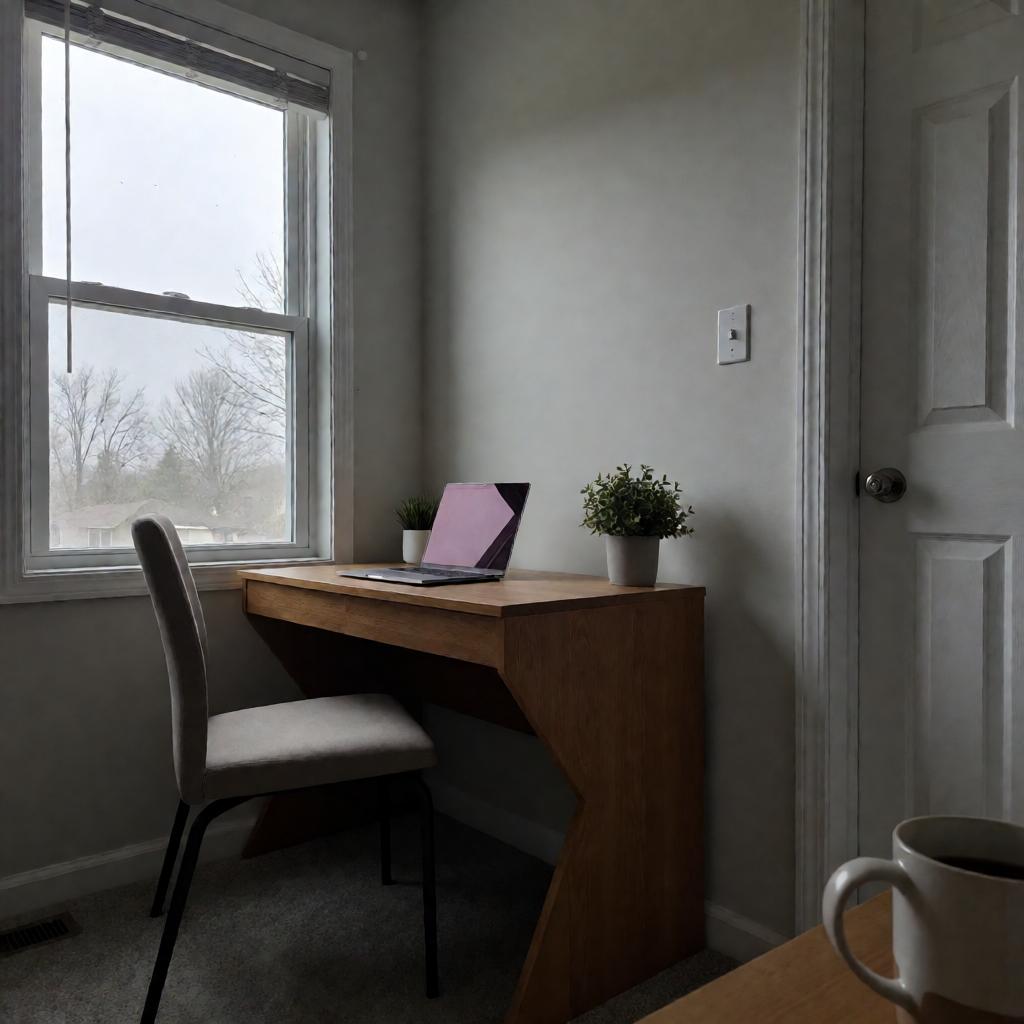
Location
Portland, Oregon, United States
Property Type
Apartment
Room
Home Office
Direction
Southeast
The Problem
I work from home as a freelance copywriter, and for months I had been struggling with a persistent afternoon slump. Every day around 2 p.m., my energy would crater. I'd stare at the screen, unable to string two sentences together. I tried coffee, walks, even standing at my desk, but nothing helped. The room itself felt heavy and oppressive, though I couldn't pinpoint why.
What They Tried
I decided to rethink the layout. My desk had been pushed against the long wall, facing a blank partition. I moved it to the corner, angled so I could see the door and the window. I also cleared the clutter—stacks of paper, old mail, a tangle of cords—and added a small plant. The shift was simple: desk in the corner, chair positioned to face the entrance, and a clear sightline to the window.
What Happened
Within a week, I noticed a change. The afternoon slump didn't vanish entirely, but it softened. I found myself less irritable and more able to push through difficult tasks. The room felt lighter, more inviting. I still have bad days, but the constant drag is gone. It's not magic—just a better setup that makes work feel less like a battle.
Spatial Orientation
| Bagua Sector | 巽 ☴ · Xun |
|---|---|
| Direction | Southeast |
| Element | wood |
What works best here
Xun (4) · Wood. Southeast loves moderate height with an airy, open feel.
Place: tall leafy plants, natural fiber rugs, light wood tones, cream and soft green.
Recommended crystal
Citrine or Green Jade — placed on a wooden side table in the southeast corner
Perfect for a creative workspace or journaling spot; natural light is your friend here
Source Analysis
1. The Original Principle
Original Chinese
七星变化无穷极,体样相同人未识。四维八干十二枝,博换化身百千亿。本自二源分派殊,不得明师述大惑。但将分受细推寻,何用劳心更劳力。凶祸之星凶祸生,福德之星招福德。造化元来指掌间,此是神仙真法则。
English Translation
The Seven Stars shift endlessly, yet their patterns repeat—most fail to see this. The four corners, eight stems, and twelve branches transform into countless forms. All stem from two sources, but without a wise teacher, confusion persists. Study these divisions carefully; no need for extra effort. A star of misfortune brings disaster; a star of fortune attracts blessings. Creation lies in the palm of your hand—this is the true immortal's rule.
2. About the Source
撼龙经 by Yang Yunsong · China · Tang Dynasty (618–907 CE)
The Dragon-Shaking Classic is a foundational text of the Form School of Chinese geomancy, compiled during the Tang Dynasty. It systematically describes how mountain formations, water flows, and land contours create spatial environments that influence human settlements. Its principles about terrain shapes and landscape energy continue to inform modern site analysis and spatial planning.
3. How This Principle Applies to This Case
The classical principle describes how recurring patterns—like the seven stars—can be read to distinguish fortunate from unfortunate arrangements. In this case, the client's original desk placement created a subtle but constant stressor: a blocked sightline and a sense of being cornered. Modern environmental psychology calls this 'prospect and refuge'—we feel safer and more focused when we can see our surroundings without being seen. By repositioning the desk to face the door, the client restored a sense of control and reduced cognitive load, which in turn improved her afternoon focus. The principle's emphasis on recognizing patterns and adjusting accordingly is reflected in this practical spatial fix.
Bring the Purest Energy Into Your Home
Sourced from altitudes above 4,000 meters in the Himalayan range — the highest place on Earth and the closest to the sun. These crystals formed over millions of years in some of the planet's most pristine conditions, untouched by industrial pollution. Each piece carries the raw, unfiltered energy of the mountains. Whether placed on a nightstand, a desk, or a meditation corner, they serve as a quiet anchor — a daily reminder to pause, breathe, and reconnect.
Explore the HIMA ALAÏA collection →Case source
Anjie Cho
NYC architect and BTB Feng Shui master. Author and co-founder of Mindful Design Feng Shui School.