I Rearranged My Home Office Desk to Face the Door and Stopped Feeling So On Edge
A freelance writer moved her desk to face the door and noticed her stress levels dropped significantly within two weeks.
Location
Portland, United States
Property Type
Apartment
Room
Home Office
Direction
North
The Problem
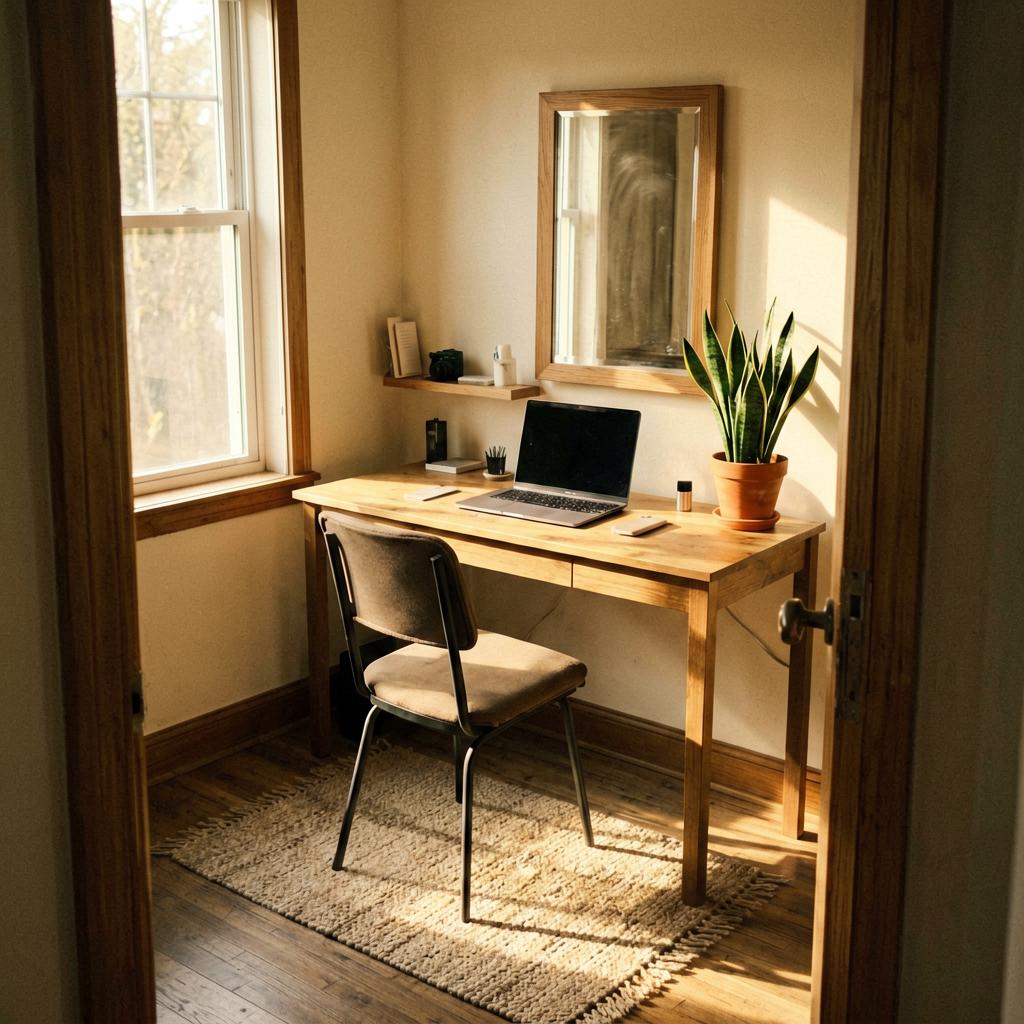
I work from home as a freelance writer, and for months, I felt constantly on edge. Every time someone walked into my home office, I'd jump. I couldn't focus, my shoulders were always tense, and I'd snap at my partner for the smallest interruptions. I tried noise-canceling headphones, meditation apps, even rearranging my schedule, but nothing helped.
What They Tried
My friend, who's a space consultant, came over and said, 'Your desk is against the wall with your back to the door. That's a lot of hidden stress.' She suggested I move the desk so it faces the door, with enough room behind me to feel open. I was skeptical—it seemed too simple—but I did it. I shifted the desk about a meter forward and placed a small plant on the corner.
What Happened
Within a week, I noticed I wasn't flinching when the door opened. I could see my partner coming, so I felt prepared instead of startled. After two weeks, my shoulders were less tight, and I wasn't as irritable. I'm not saying it's a miracle cure, but it made a real difference in my daily focus and mood.
Spatial Orientation
| Bagua Sector | 坎 ☵ · Kan |
|---|---|
| Direction | North |
| Element | water |
What works best here
Kan (1) · Water. North side can be slightly taller than South for a grounded feel.
Place: dark-colored ceramics, stone objects, heavy bookshelves.
Recommended crystal
Black Obsidian or Smoky Quartz — placed on a low table or shelf in the north corner
A solid, weighty presence here helps the room feel anchored and secure
Source Analysis
1. The Original Principle
Original Chinese
乾坤艮兑,为太阳太阴所生,老父老母,少男少女,配合而成家之象;坎离震巽,为少阳少阴所生,有长男长女,中男中女,配合成家之象。
English Translation
The eight trigrams represent family roles in spatial design. Heaven and Lake form the parents and youngest children. Water, Fire, Thunder, and Wind represent the middle and eldest children. These pairings create a complete household.
2. About the Source
八宅明镜上卷 by Yang Yunsong (attributed) · China · Qing Dynasty (1644–1912 CE)
The Eight Mansions Bright Mirror is one of the most influential classical Chinese texts on residential architecture. For over three centuries, it has served as a foundational reference for understanding how the layout and orientation of living spaces affect the wellbeing of their inhabitants, focusing on how living spaces can be arranged to support health, relationships, and prosperity.
3. How This Principle Applies to This Case
This case illustrates a core spatial principle: the relationship between a person's position and their sense of security. In classical spatial analysis, the 'commanding position'—where one can see the entry while working—is considered essential for feeling grounded. Modern environmental psychology supports this: having your back to an open doorway triggers a subconscious vigilance response, as the brain cannot monitor potential threats. By facing the door, the writer reduced that background anxiety, allowing her nervous system to relax. The change wasn't mystical; it addressed a basic human need for visual control over one's surroundings.
Bring the Purest Energy Into Your Home
Sourced from altitudes above 4,000 meters in the Himalayan range — the highest place on Earth and the closest to the sun. These crystals formed over millions of years in some of the planet's most pristine conditions, untouched by industrial pollution. Each piece carries the raw, unfiltered energy of the mountains. Whether placed on a nightstand, a desk, or a meditation corner, they serve as a quiet anchor — a daily reminder to pause, breathe, and reconnect.
Explore the HIMA ALAÏA collection →Case source
RD Chin, Feng Shui Architect
NYC licensed architect, Feng Shui master, and published author. Worked under legendary architect Paul Rudolph. Specializes in complex residential and commercial blueprint Feng Shui assessment and spatial flow micro-adjustments. Conducts Feng Shui public courses across the US.