I Swapped My Home Office and Guest Room — My Focus (and Marriage) Improved in 3 Weeks
A remote worker swaps his home office from the noisy front room to a quieter back bedroom and notices his concentration and patience improve within weeks.
Location
Portland, Oregon, United States
Property Type
Apartment
Room
Home Office
Direction
North
The Problem
I'd been working from the front room of our two-bedroom apartment for almost two years. It was supposed to be a home office, but it was really just a desk shoved into the corner of the living room, right next to the window that faced the street. Every delivery truck, every neighbor's car door, every dog walker — I heard it all. My focus was shot. I'd sit down at 9 a.m. with a clear plan and by 11 I'd have written maybe three sentences. Worse, I started snapping at my wife over tiny things. The dishwasher. The mail. Stuff that never used to bother me. I felt like I was constantly braced for the next interruption, even when the room was quiet.
What They Tried
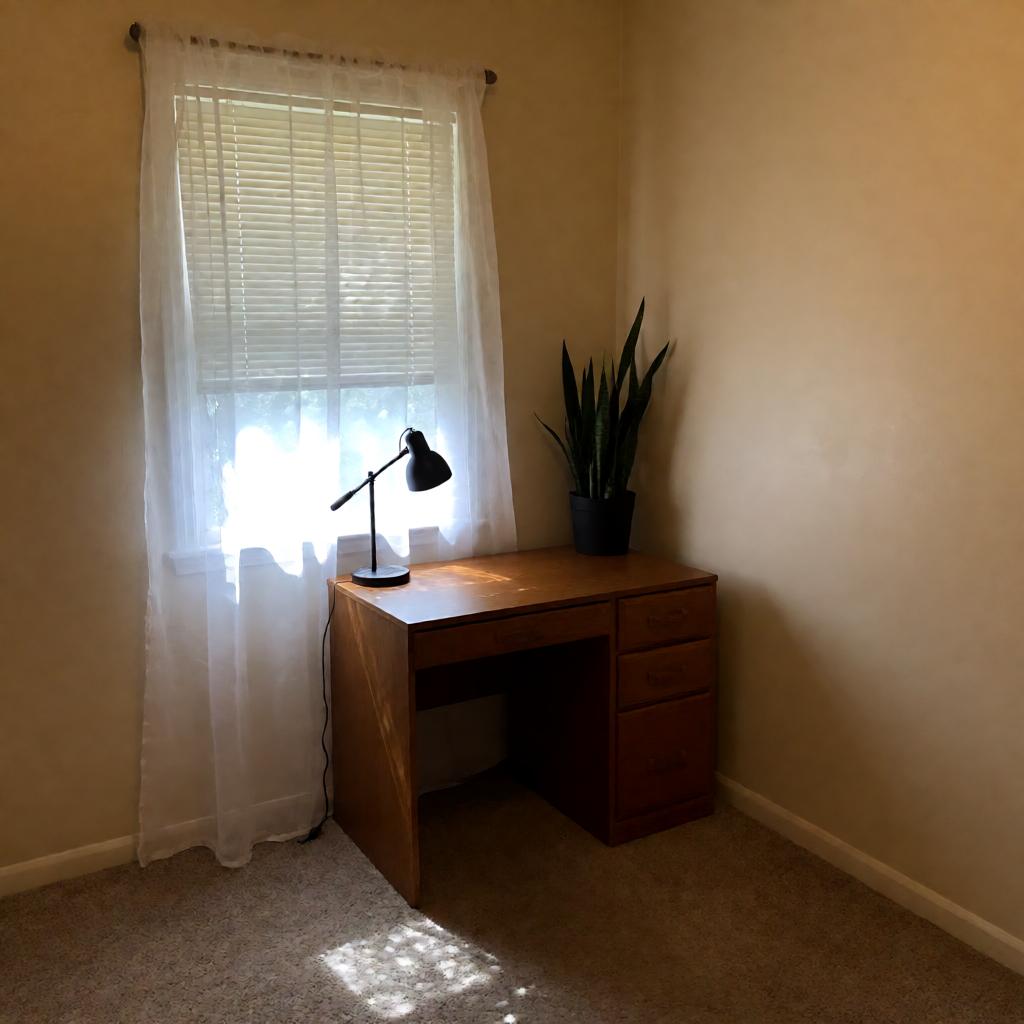
My wife suggested we swap rooms. The guest room — a small bedroom at the back of the apartment — was barely used. I resisted at first because it felt like giving up on the 'office.' But we moved the desk to the back room, placed it against the wall opposite the door, with the window to my left instead of directly in front of me. I added a small shelf behind my chair, a lamp on the desk, and a plant in the corner. We put a curtain over the window to soften the light. The old front-room desk became a console table for mail and keys.
What Happened
The first week was strange — the room felt too quiet. But by week three I noticed I was finishing tasks before lunch. I wasn't checking my phone as often. And I was less irritable in the evenings. It's not magic. I think the back room just removed the constant low-grade alertness I didn't realize I was carrying. My wife said I seemed 'less like a coiled spring.' I'll take it.
Spatial Orientation
| Bagua Sector | 坎 ☵ · Kan |
|---|---|
| Direction | North |
| Element | water |
What works best here
Kan (1) · Water. North side can be slightly taller than South for a grounded feel.
Place: dark-colored ceramics, stone objects, heavy bookshelves.
Recommended crystal
Black Obsidian or Smoky Quartz — placed on a low table or shelf in the north corner
A solid, weighty presence here helps the room feel anchored and secure
Source Analysis
1. The Original Principle
Original Chinese
乾为老父寿卦,坤为老母阴卦,震为长男贵卦,巽为长女淫卦,坎为中男劳卦,离为中女财卦,艮为少男财卦,兑为少女说卦。
English Translation
The eight trigrams each carry specific attributes: Qian relates to the elder father and longevity; Kun to the elder mother and receptivity; Zhen to the eldest son and nobility; Xun to the eldest daughter; Kan to the middle son and toil; Li to the middle daughter and wealth; Gen to the youngest son and wealth; Dui to the youngest daughter and speech. Each direction and its corresponding trigram influences the character of a dwelling.
2. About the Source
金锁玉关 by Anonymous (private manuscript) · China · Pre-Song Dynasty (before 960 CE)
The Golden Lock and Jade Pass is an esoteric classical text on residential site analysis, passed down through private manuscripts. It provides a systematic method for evaluating how the surrounding landforms — heights, depressions, and water features in each compass direction — shape the experience of a living space. Its sand-and-water framework remains one of the most practical tools in the landscape assessment tradition.
3. How This Principle Applies to This Case
This case illustrates the classical principle that different spaces carry different functional attributes. The back bedroom, associated with quieter, more settled qualities, proved better suited for focused work than the high-traffic front room. Modern environmental psychology supports this: chronic background noise and visual motion keep the nervous system in a low-level stress response, impairing concentration and emotional regulation. Moving the workspace to a calmer zone reduced sensory load, allowing the occupant to shift from reactive alertness to sustained attention. The change wasn't mystical — it was spatial. The room's position and exposure did the work.
Bring the Purest Energy Into Your Home
Sourced from altitudes above 4,000 meters in the Himalayan range — the highest place on Earth and the closest to the sun. These crystals formed over millions of years in some of the planet's most pristine conditions, untouched by industrial pollution. Each piece carries the raw, unfiltered energy of the mountains. Whether placed on a nightstand, a desk, or a meditation corner, they serve as a quiet anchor — a daily reminder to pause, breathe, and reconnect.
Explore the HIMA ALAÏA collection →Case source
Nicolette Vajtay
Feng Shui consultant helping clients transform their homes through intentional spatial design.