My Friend Moved a Small Pile of Rocks to the Middle of Her Living Room Floor — And I Watched Her Whole Mood Change
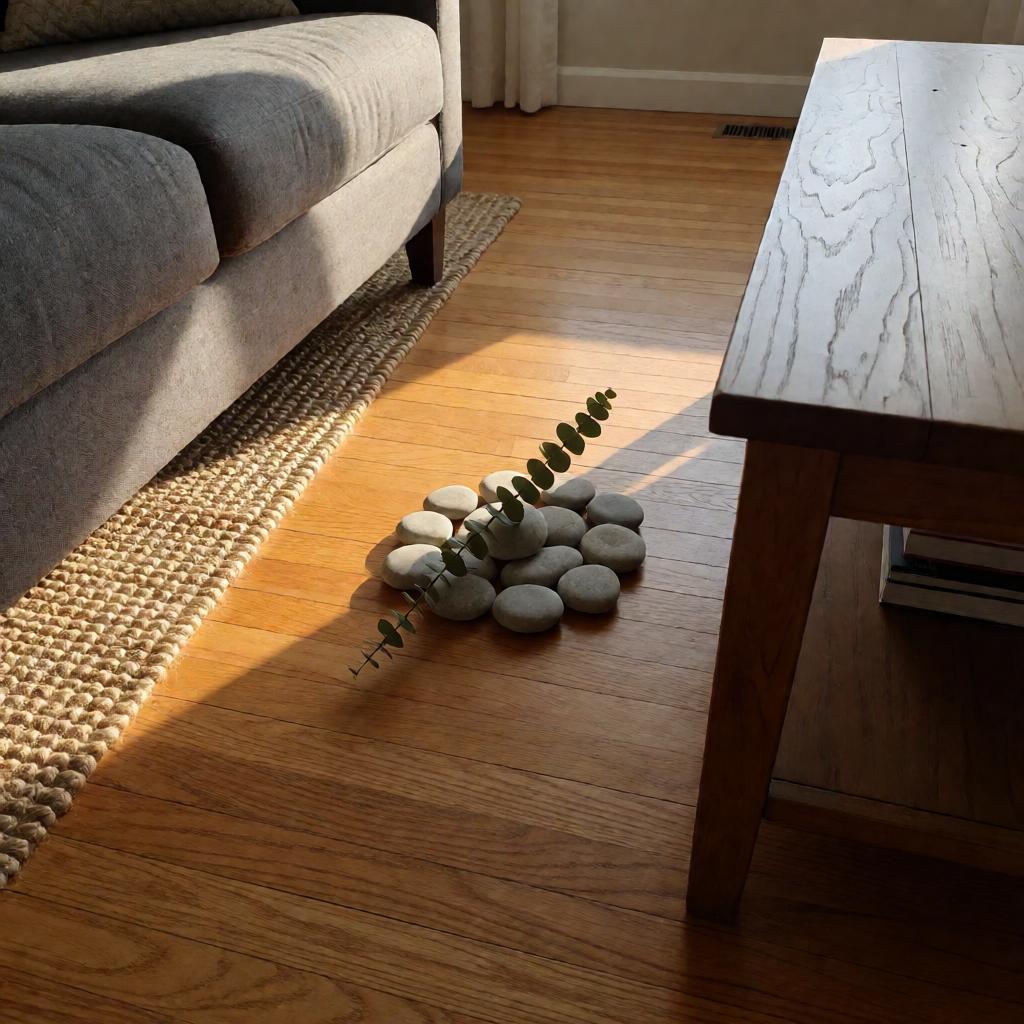
After months of anxiety and restlessness, my friend Jenna placed a small mound of stones in the center of her apartment's main room. I thought it was odd, but the shift in her behavior over the next few weeks was hard to ignore.
Location
Portland, Oregon, United States
Property Type
Apartment
Room
Living Room
Direction
Center
The Problem
You know that feeling when a room just feels... off? That was Jenna's apartment. She'd been living there for two years, and lately she couldn't sit still. She'd start a movie, pause it ten minutes in, reorganize a shelf, then abandon that too. Nothing was wrong exactly — she had a good job, a decent social life — but she described it as 'background static.' Her words. She said the living room, which was a long rectangle with the couch pushed against one wall, felt like a hallway she was always passing through, never actually in. She tried changing the throw pillows, then the lighting, then she gave up for a while and just avoided the room entirely.
What They Tried
One weekend she came back from a walk by the river with a canvas bag full of smooth stones — maybe fifteen or twenty of them, all grey and flat. She cleared a small patch on the hardwood floor right in the middle of the living room, between the couch and the coffee table, and arranged the stones into a low, wide mound, maybe four inches high and a foot across. She put a single sprig of eucalyptus on top. That was it. No explanation. When I asked, she just shrugged and said, 'I wanted something in the center that wasn't furniture.'
What Happened
I visited her a week later. The first thing I noticed was that we sat in the living room the whole time — not the kitchen, not standing by the door. She didn't get up once to fix anything. Over the next month, she told me she started reading there again, actually finishing chapters. She said the room felt 'anchored.' I don't know if it was the stones themselves or just the act of claiming that empty space, but something loosened. She still has bad days. But she stopped avoiding her own living room.
Spatial Orientation
| Bagua Sector | Center |
|---|---|
| Direction | Center |
What works best here
Center (5) · Earth. The center should be the most open area — avoid tall dividers or heavy furniture.
Place: an open rug, a low coffee table, even ambient lighting, a central plant.
Recommended crystal
Clear Quartz or Amethyst cluster — placed as a centerpiece on a coffee table or console
This is the heart of the room. Keep pathways open and let energy circulate freely
Source Analysis
1. The Original Principle
Original Chinese
穷源千仞,不如平地一堆;
English Translation
A classical landscape text observes that a single mound on flat ground is more valuable than a thousand-fathom peak in distant mountains. The reasoning: flat terrain allows subtle forces to gather and rise gently, whereas dramatic heights disperse them. The principle applies to small, deliberate focal points in otherwise featureless spaces.
2. About the Source
雪心赋 论水口 by Bu Yingtian · China · Tang Dynasty (618–907 CE)
The Snow Heart Rhapsody is a poetic yet rigorously analytical classical text on landscape assessment. Written in rhymed prose, it covers mountain forms, water patterns, terrain energy, and site selection with remarkable literary elegance. Its observations about how land contours create sheltered, comfortable settings for human habitation remain relevant to modern site planning and environmental psychology.
3. How This Principle Applies to This Case
This case illustrates a principle from classical Chinese landscape observation: a low mound on flat ground is more potent than a towering peak, because gentle, contained rises allow subtle influences to accumulate. Applied to interiors, a small, deliberate focal point in an otherwise undifferentiated room can create a sense of psychological center. Modern environmental psychology supports this — humans orient more easily in spaces with a clear point of reference. The mound gave Jenna's living room a 'center of gravity,' reducing the restlessness caused by a space that felt like a corridor. The change was not magical; it was spatial.
Bring the Purest Energy Into Your Home
Sourced from altitudes above 4,000 meters in the Himalayan range — the highest place on Earth and the closest to the sun. These crystals formed over millions of years in some of the planet's most pristine conditions, untouched by industrial pollution. Each piece carries the raw, unfiltered energy of the mountains. Whether placed on a nightstand, a desk, or a meditation corner, they serve as a quiet anchor — a daily reminder to pause, breathe, and reconnect.
Explore the HIMA ALAÏA collection →Case source
Feng Shui Style
Featured on HGTV. Specializes in Classical Liqi Pai (San Yuan Xuan Kong Fei Xing, Ba Zhai Ming Jing) and historic home restoration with deep Feng Shui integration.