My Friend Moved Her Bedroom Mirror to the Closet Door — And Stopped Waking at 3AM
A friend's persistent 3AM waking stopped after she moved a full-length mirror from beside her bed to the inside of her closet door.
Location
Portland, Oregon, United States
Property Type
Apartment
Room
Bedroom
Direction
East
The Problem
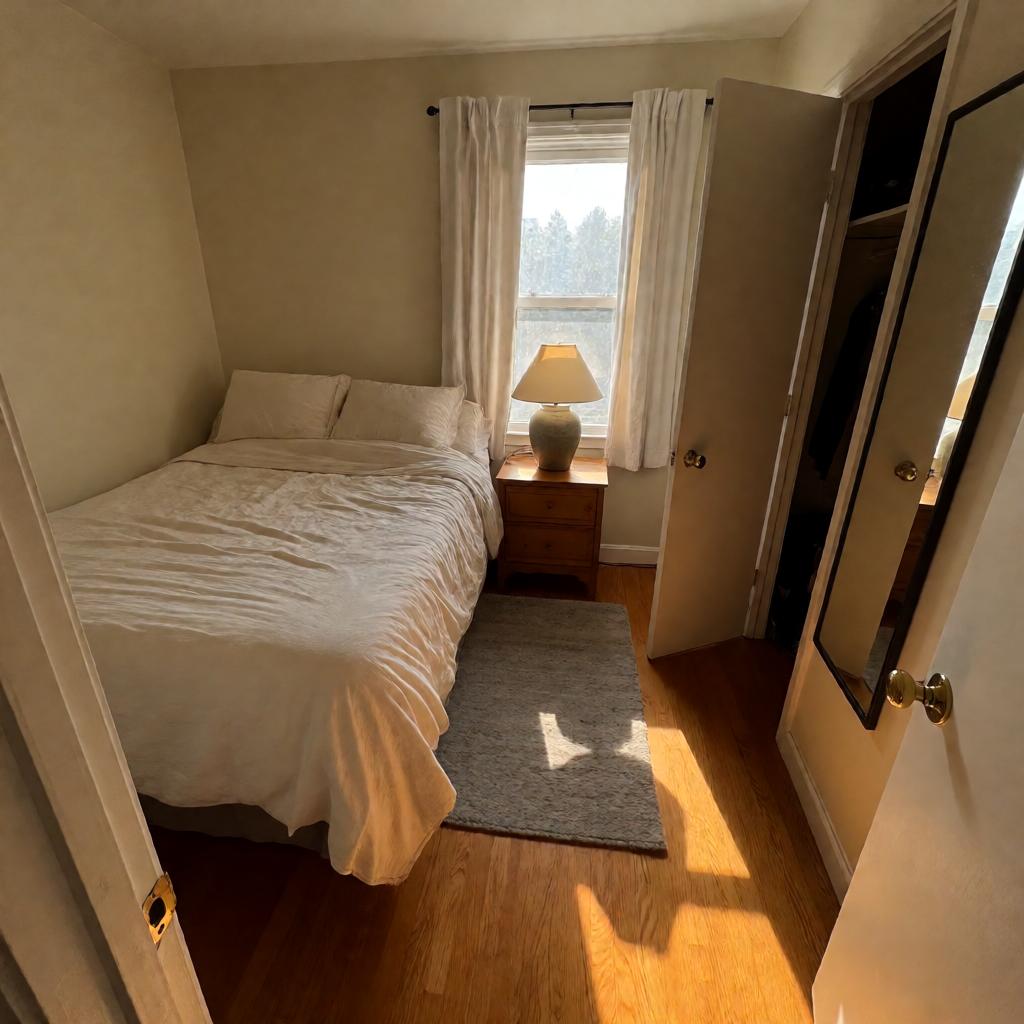
My friend Dana hadn't slept through the night in almost four months. She'd wake up at 3AM like clockwork, heart pounding, convinced someone was in the room. She tried melatonin, white noise, a weighted blanket. Nothing worked. Her bedroom was small — maybe ten by twelve — with a single window facing east. The only thing on the wall across from her bed was a full-length mirror she'd leaned there two years ago because she didn't know where else to put it.
What They Tried
I suggested she move the mirror. She thought I was joking. But she was desperate enough to try it. She took it off the wall and hung it inside her closet door, where it faced the back wall and nothing else. That was the only change she made.
What Happened
She didn't sleep perfectly the first night. But she didn't wake at 3AM either. By the end of the second week, she was sleeping through until her alarm. She told me she still doesn't fully understand why it worked — but she's not moving it back.
Spatial Orientation
| Bagua Sector | 震 ☳ · Zhen |
|---|---|
| Direction | East |
| Element | wood |
What works best here
Zhen (3) · Wood. East should be the tallest area of the room when possible.
Place: tall plants (especially bamboo or fiddle-leaf fig), wooden furniture, green accents.
Recommended crystal
Green Aventurine or Moss Agate — placed near a window or on a plant shelf in the east
This is the growth sector — plants thrive here and vertical elements feel natural
Source Analysis
1. The Original Principle
Original Chinese
木须有节。金贵连珠。
English Translation
When the wood element appears in a space, it should have clear joints or nodes — like bamboo. When the metal element flows, it should move in connected beads, like a string of pearls. A mirror placed where it breaks the resting line of the room acts like a knot in smooth wood.
2. About the Source
雪心赋 论五星转换 by Bu Yingtian · China · Tang Dynasty (618–907 CE)
The Snow Heart Rhapsody is a poetic yet rigorously analytical classical text on landscape assessment. Written in rhymed prose, it covers mountain forms, water patterns, terrain energy, and site selection with remarkable literary elegance. Its observations about how land contours create sheltered, comfortable settings for human habitation remain relevant to modern site planning and environmental psychology.
3. How This Principle Applies to This Case
The classical principle distinguishes between two kinds of spatial movement: wood, which should have clear joints, and metal, which should flow in connected beads. A mirror placed opposite a bed interrupts the resting sightline — it creates a visual knot where the eye expects continuity. Modern sleep research supports this: the brain processes reflective surfaces in peripheral vision as potential movement, triggering micro-arousals during light sleep phases. Moving the mirror removed the visual interruption without changing anything else in the room. The principle isn't about the mirror itself — it's about whether the space reads as continuous or broken.
Bring the Purest Energy Into Your Home
Sourced from altitudes above 4,000 meters in the Himalayan range — the highest place on Earth and the closest to the sun. These crystals formed over millions of years in some of the planet's most pristine conditions, untouched by industrial pollution. Each piece carries the raw, unfiltered energy of the mountains. Whether placed on a nightstand, a desk, or a meditation corner, they serve as a quiet anchor — a daily reminder to pause, breathe, and reconnect.
Explore the HIMA ALAÏA collection →Case source
Wind & Water School of Feng Shui
Minnesota Feng Shui pioneer. Founded a professional Feng Shui school and has consulted for major hospitals, banks, and corporate headquarters across the US.