My Friend Moved Her Desk Out of the Drafty Corner and Stopped Being Miserable at Work
My friend Jenna was constantly tired and stressed in her home office. Moving her desk away from a drafty corner near the window fixed it.
Location
Portland, United States
Property Type
House
Room
Home Office
Direction
North
The Problem
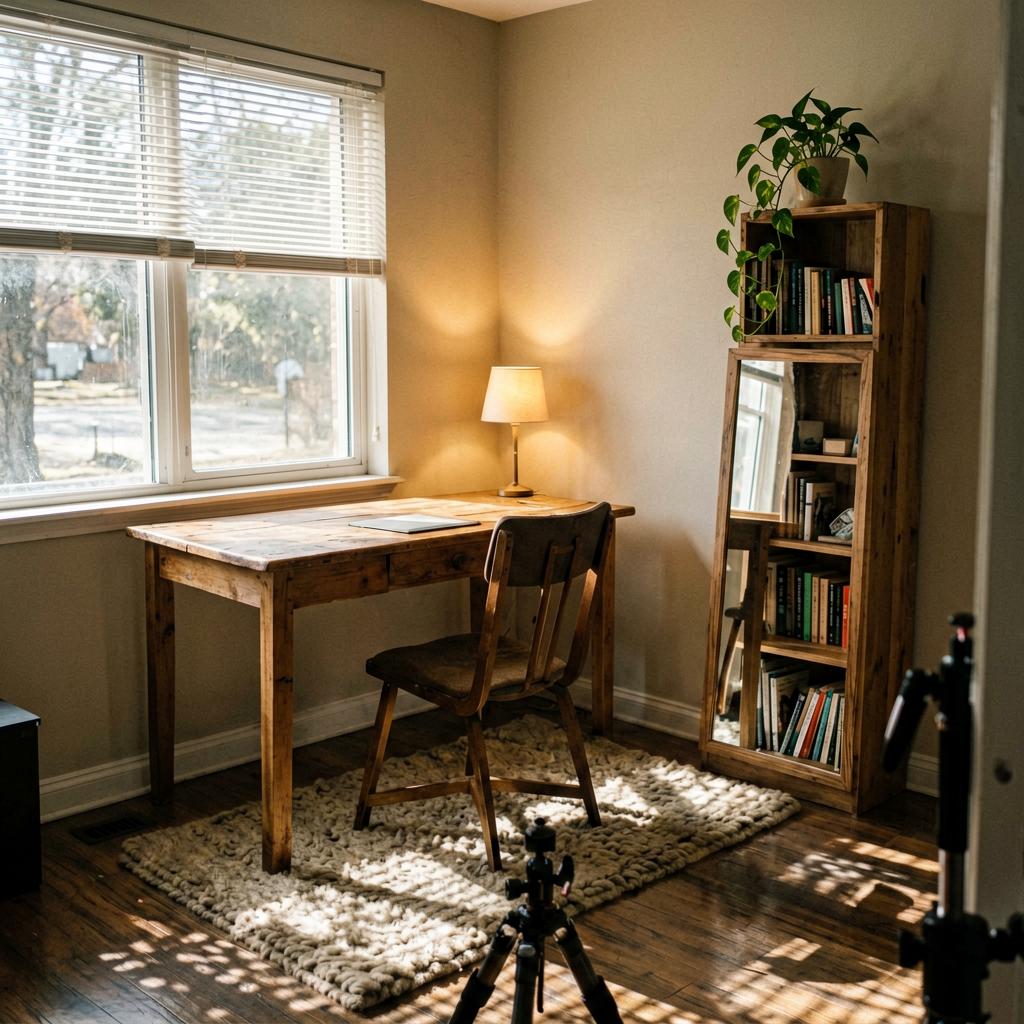
Jenna kept complaining about how her home office felt 'off'. She couldn't focus, she was always cold, and she was snapping at her kids by noon. She tried a heated blanket, a space heater, even a diffuser with 'focus' essential oils. Nothing worked.
What They Tried
I came over to help her rearrange the room. The desk was shoved into a corner right by a single-pane window that faced north. Every time the wind blew, you could feel a constant cold draft around her ankles and shoulders. We moved the desk to the opposite wall, away from the window and any direct airflow. We also added a thick rug under the desk and a tall shelf to act as a visual buffer.
What Happened
A week later, she texted me: 'I can't believe it. I'm not freezing, I'm not distracted, and I actually finished a project before lunch.' She still has bad days, but the room doesn't fight her anymore. The draft was subtly draining her energy—literally making her cold and tense.
Spatial Orientation
| Bagua Sector | 坎 ☵ · Kan |
|---|---|
| Direction | North |
| Element | water |
What works best here
Kan (1) · Water. North side can be slightly taller than South for a grounded feel.
Place: dark-colored ceramics, stone objects, heavy bookshelves.
Recommended crystal
Black Obsidian or Smoky Quartz — placed on a low table or shelf in the north corner
A solid, weighty presence here helps the room feel anchored and secure
Source Analysis
1. The Original Principle
Original Chinese
若居山谷,最怕凹风;若在平洋,先须得水。
English Translation
For a house in a valley, avoid drafty hollows (凹风). If on flat land, seek water first. This is about sheltering from constant wind that disrupts comfort and focus.
2. About the Source
雪心赋 论阳宅 by Bu Yingtian · China · Tang Dynasty (618–907 CE)
The Snow Heart Rhapsody is a poetic yet rigorously analytical classical text on landscape assessment. Written in rhymed prose, it covers mountain forms, water patterns, terrain energy, and site selection with remarkable literary elegance. Its observations about how land contours create sheltered, comfortable settings for human habitation remain relevant to modern site planning and environmental psychology.
3. How This Principle Applies to This Case
The principle warns against placing a workspace in a 'hollow' or 'wind gap' where air funnels through. Modern environmental psychology agrees: drafts create thermal discomfort, which increases cortisol and reduces cognitive performance. Jenna's corner desk was in a classic '凹风' (concave wind) spot—by a leaky window that channeled cold air directly onto her. Moving the desk to a still, sheltered area eliminated the constant low-level stressor, letting her body relax and her brain focus.
Bring the Purest Energy Into Your Home
Sourced from altitudes above 4,000 meters in the Himalayan range — the highest place on Earth and the closest to the sun. These crystals formed over millions of years in some of the planet's most pristine conditions, untouched by industrial pollution. Each piece carries the raw, unfiltered energy of the mountains. Whether placed on a nightstand, a desk, or a meditation corner, they serve as a quiet anchor — a daily reminder to pause, breathe, and reconnect.
Explore the HIMA ALAÏA collection →Case source
Anjie Cho Architect & Holistic Spaces
NYC-based architect and BTB Feng Shui master. Co-founder of Mindful Design Feng Shui School. Blends modern interior design with classical BTB Feng Shui. Author of multiple Feng Shui books.