My Friend Said 'Move Your Desk to Face the Door' — I Thought She Was Crazy, Then I Tried It
A skeptical graphic designer in Portland moves her home office desk to face the door and finds her focus returns within weeks.
Location
Portland, Oregon, United States
Property Type
Apartment
Room
Home Office
Direction
North
The Problem
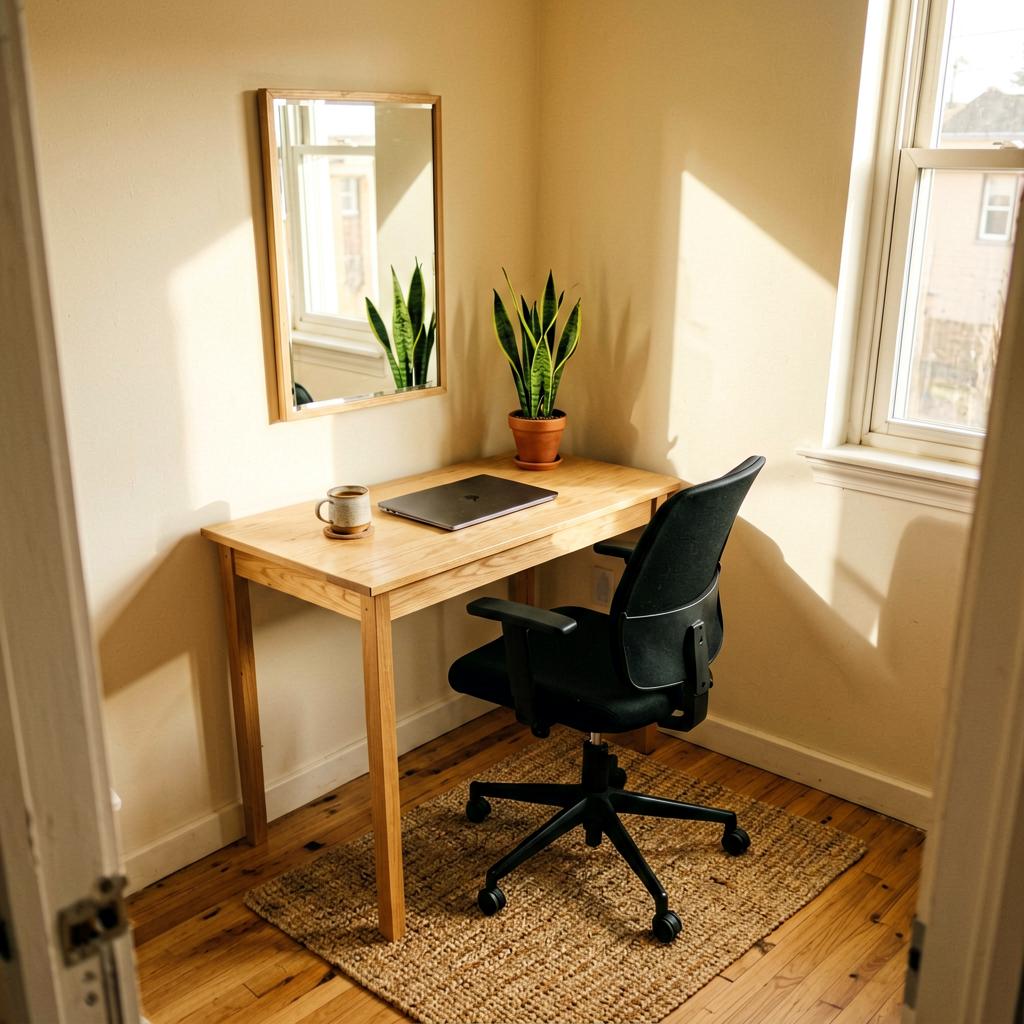
I'd been working from home for about eight months, and somewhere around month five I started dreading my desk. I have a tiny home office in the corner of my living room — maybe six by eight feet — with a window facing north. I'd set the desk up against the wall so I could look out the window while I worked. At first it was nice. Then it became a slow descent into distraction. I was checking my phone every ten minutes. Answering emails I could have ignored. Getting up for snacks I didn't want. By the end of the day, I'd have maybe two solid hours of work done and a vague sense of failure. I tried everything: the pomodoro method, a standing desk converter, noise-cancelling headphones, even those productivity apps that shame you. Nothing stuck.
What They Tried
My friend Maya came over for coffee one Saturday and stood in my doorway, frowning. 'You know your desk is facing the wrong way, right?' I laughed. She's a landscape designer, not an interior decorator. But she explained that she'd learned this from a client — that when you sit with your back to the door, you're constantly half-listening for someone to come in. Your brain never fully relaxes. I was skeptical, but I was also desperate. That afternoon, I unplugged everything and rotated the desk ninety degrees so I was sitting with my back to the window, facing the door. It took twenty minutes. I moved a small plant to the corner where the desk used to be. Done.
What Happened
It wasn't magic. The first two days felt weird — I kept turning around to look at the window. But by the end of the first week, I noticed something: I wasn't checking my phone as much. By week three, I was finishing my work by 4pm instead of 6pm. Maya came back over and said, 'See? You're not waiting for someone to sneak up on you anymore.' I still get distracted sometimes. But it's different now. The room feels like a place where I work, not a place where I hide.
Spatial Orientation
| Bagua Sector | 坎 ☵ · Kan |
|---|---|
| Direction | North |
| Element | water |
What works best here
Kan (1) · Water. North side can be slightly taller than South for a grounded feel.
Place: dark-colored ceramics, stone objects, heavy bookshelves.
Recommended crystal
Black Obsidian or Smoky Quartz — placed on a low table or shelf in the north corner
A solid, weighty presence here helps the room feel anchored and secure
Source Analysis
1. The Original Principle
Original Chinese
择焉而不精,误于管见。谓凶为吉,指吉为凶。注解:择吉而不精,误于一管之见。把凶说成吉,把吉说成凶。
English Translation
A classical text warns that when people choose auspicious times or positions carelessly, they mistake bad for good and good for bad. The same principle applies to spatial arrangements: a careless placement can turn a productive spot into a draining one. Careful observation, not guesswork, is required.
2. About the Source
雪心赋 论克择 by Bu Yingtian · China · Tang Dynasty (618–907 CE)
The Snow Heart Rhapsody is a poetic yet rigorously analytical classical text on landscape assessment. Written in rhymed prose, it covers mountain forms, water patterns, terrain energy, and site selection with remarkable literary elegance. Its observations about how land contours create sheltered, comfortable settings for human habitation remain relevant to modern site planning and environmental psychology.
3. How This Principle Applies to This Case
The story illustrates a simple but overlooked principle: precision in placement matters. The classical text warns against 'one-sided views' — judging a situation without considering the full context. In this case, the desk was placed for a view, not for security. Modern environmental psychology supports this: humans have a hardwired 'surveillance' instinct, and sitting with your back to an open doorway keeps the nervous system on low alert. The fix wasn't mystical — it was precise. By rotating the desk to face the door, the narrator removed a subtle but constant source of stress. The classical principle applies here not as superstition, but as a reminder: don't guess. Observe. Adjust. Then verify.
Bring the Purest Energy Into Your Home
Sourced from altitudes above 4,000 meters in the Himalayan range — the highest place on Earth and the closest to the sun. These crystals formed over millions of years in some of the planet's most pristine conditions, untouched by industrial pollution. Each piece carries the raw, unfiltered energy of the mountains. Whether placed on a nightstand, a desk, or a meditation corner, they serve as a quiet anchor — a daily reminder to pause, breathe, and reconnect.
Explore the HIMA ALAÏA collection →Case source
Wind & Water School of Feng Shui
Minnesota Feng Shui pioneer. Founded a professional Feng Shui school and has consulted for major hospitals, banks, and corporate headquarters across the US.