My Home Office Was Draining Me. Then I Painted It Terracotta, Bought a Rug, and Moved My Desk by the Window.
A freelance writer, struggling with creative block and low energy, transformed her home office with intentional color, natural light, and personal objects—and found her focus again.
Location
Portland, Oregon, United States
Property Type
Apartment
Room
Home Office
Direction
East
The Problem
I was supposed to be writing, but I couldn't focus. My home office—a spare bedroom I'd been using for three years—felt like a punishment. The walls were an off-white that had gone gray from the cheap paint I'd used. The only window was behind my monitor, so I sat with my back to it, and the overhead light flickered. I'd set up my desk against the wall like I did in my college dorm, with a bunch of cords dangling behind it. I'd constantly get up to stretch, get water, check my phone—anything to avoid sitting back down. My productivity tanked, and I started dreading going in there. I'd work from the couch, which made my neck hurt. I needed a change, but I didn't know what kind.
What They Tried
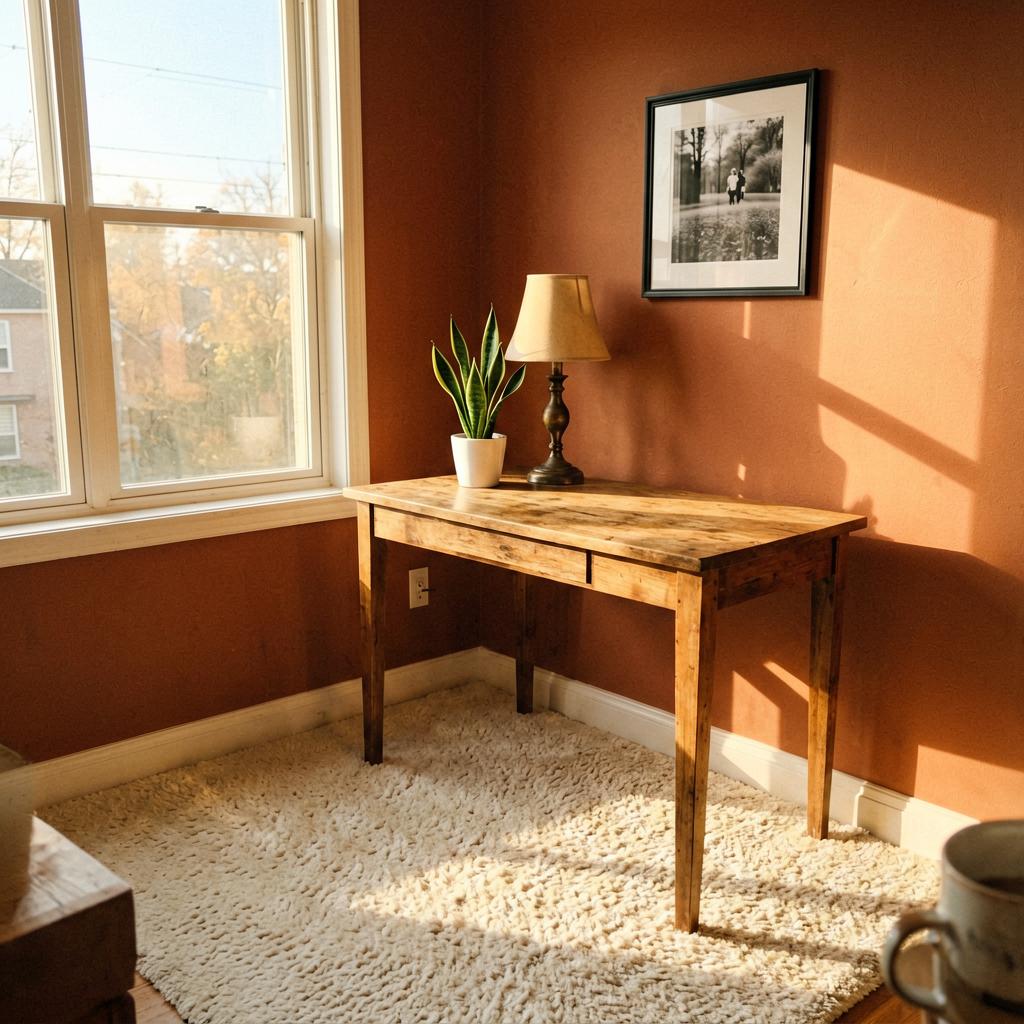
I finally took a weekend to redo the room. First, I painted the walls a warm terracotta—Sherwin-Williams 'Cavern Clay'—which felt bold but cozy. I moved the desk so it faced the window, with the morning light coming in from the side. I bought a thick, natural wool rug in a cream color to soften the floor. Then I added things that actually meant something to me: a framed photo from a trip to Portugal, a small snake plant on the corner of the desk, and a vintage lamp I'd found at a flea market. I also hung a simple shelf and put a few books I love on it. I didn't follow any rules—I just chose things I liked looking at.
What Happened
The first morning I sat down to work, I actually wanted to be there. The light felt good. The warm color on the walls made the room feel smaller, but in a good way—like a den. I started getting into a flow state again. I wasn't perfect—I still got distracted—but I stopped avoiding the room. After a couple of weeks, I realized I was writing more, and the work felt less like a chore. I even started looking forward to my morning coffee at that desk. It wasn't a miracle cure, but it was a real shift. The room felt like mine now, not just a leftover space.
Spatial Orientation
| Bagua Sector | 震 ☳ · Zhen |
|---|---|
| Direction | East |
| Element | wood |
What works best here
Zhen (3) · Wood. East should be the tallest area of the room when possible.
Place: tall plants (especially bamboo or fiddle-leaf fig), wooden furniture, green accents.
Recommended crystal
Green Aventurine or Moss Agate — placed near a window or on a plant shelf in the east
This is the growth sector — plants thrive here and vertical elements feel natural
Source Analysis
1. The Original Principle
Original Text
Será libre para crear su propio paraíso: un lugar en el que estará rodeado de sus reafirmaciones sobre el entorno, y de sus elecciones en lo relativo a la iluminación, el arte, el mobiliario, los colores, diseño, objetos naturales y estructuras arquitectónicas. Se trata de un lugar en el que el chi fluye de forma armoniosa en cada una de las habitaciones, sosteniendo su hogar a la vez que le inspira, le rejuvenece, le reconforta y le protege.
English Translation
You are free to create your own paradise: a place where you are surrounded by your affirmations of the environment, and by your choices regarding lighting, art, furniture, colors, design, natural objects, and architectural structures. It is a place where the flow is harmonious in each room, supporting your home while inspiring, rejuvenating, comforting, and protecting you.
2. About the Source
Feng shui para Occidente by Terah Kathryn Collins · United States · 1995
Feng Shui for the West is a practical guide that adapts classical Chinese spatial principles for modern Western homes and lifestyles. Written by one of the first American authors to bring Feng Shui to a mainstream English-speaking audience, the book translates ancient Bagua concepts into actionable room-by-room advice using familiar Western design language and contemporary case examples.
3. How This Principle Applies to This Case
This case illustrates the principle of personalized space creation—the idea that a room should reflect the inhabitant's own choices and preferences, not generic design rules. The narrator's previous office was a functional default: white walls, desk against wall, harsh lighting. By intentionally selecting colors, materials, and objects that carried personal meaning, she transformed the room into a supportive environment. Modern environmental psychology supports this: personalization increases a sense of control and belonging, which reduces stress and improves cognitive performance. The warm color (terracotta) and natural elements (wool rug, plant) also engage the senses in a way that neutral spaces do not, making the room feel more 'settled' and less like a temporary arrangement.
Bring the Purest Energy Into Your Home
Sourced from altitudes above 4,000 meters in the Himalayan range — the highest place on Earth and the closest to the sun. These crystals formed over millions of years in some of the planet's most pristine conditions, untouched by industrial pollution. Each piece carries the raw, unfiltered energy of the mountains. Whether placed on a nightstand, a desk, or a meditation corner, they serve as a quiet anchor — a daily reminder to pause, breathe, and reconnect.
Explore the HIMA ALAÏA collection →Case source
Sacred Spaces Design
Independent sacred space design studio. Integrates psychology, herbal plant energy purification, decluttering, and Feng Shui orientation. Large young-entrepreneur following in NYC and online.