My Therapist Said 'Stop Apologizing to Your House' — So I Reconfigured My Living Room Furniture
A woman realizes her apartment's layout is causing her constant stress, and a simple furniture swap changes everything.
Location
Portland, Oregon, United States
Property Type
Apartment
Room
Living Room
Direction
Southeast
The Problem
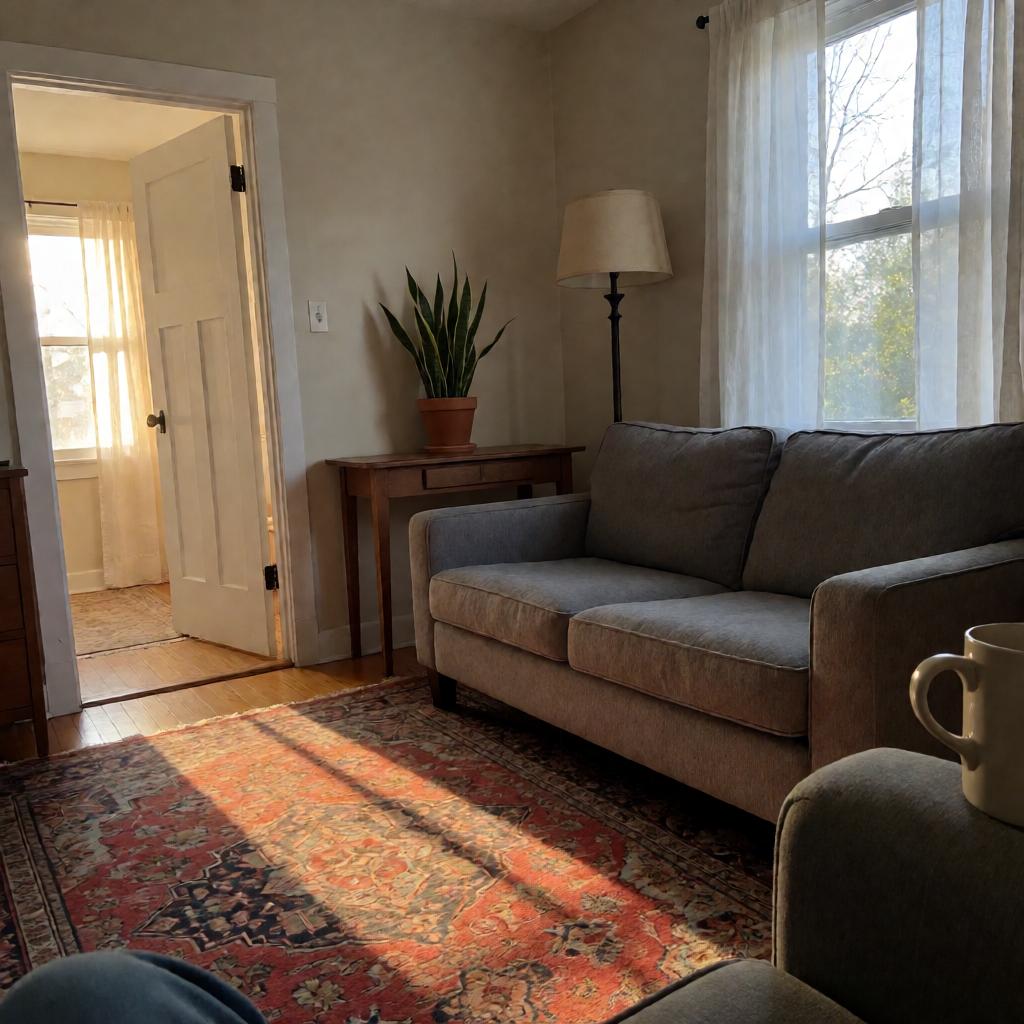
Every time I walked into my living room, I felt this weird pressure in my chest. Like I was about to be scolded. I couldn't figure out why — it's a nice room, big windows, decent couch. But I started avoiding it. I'd eat standing up in the kitchen, work from my bed, basically live in every room except the one designed for living. My therapist noticed I kept saying 'sorry' for no reason during our sessions. She asked where I felt most 'on edge' at home. I said the living room. She said, 'What does it look like from the doorway?' I sent her a photo. She said, 'Oh. Your back is to the door the whole time.'
What They Tried
I moved the couch. That's it. That's the whole fix. The sofa used to face the TV, which meant anyone sitting on it had their back to the entrance. I swapped the couch and the TV stand, so now the seating faces the door at a slight angle. I also put a small console table behind the couch — just a cheap one from IKEA — to create a little buffer. The room didn't get bigger. The furniture didn't change. But the moment I sat down in the new spot, I exhaled. Like actually exhaled. My roommate walked in and said, 'Why does this feel different?' I said, 'I don't know, but I'm not moving it back.'
What Happened
I started using the living room again. Not dramatically — I'm not hosting dinner parties now. But I read there. I drink my coffee there. The 'sorry' thing in therapy? Down by like 80%. I didn't realize how much energy I was spending bracing myself. The room still has the same weird corner where the radiator sticks out. But now I sit where I can see who's coming, and my body just... relaxes.
Spatial Orientation
| Bagua Sector | 巽 ☴ · Xun |
|---|---|
| Direction | Southeast |
| Element | wood |
What works best here
Xun (4) · Wood. Southeast loves moderate height with an airy, open feel.
Place: tall leafy plants, natural fiber rugs, light wood tones, cream and soft green.
Recommended crystal
Citrine or Green Jade — placed on a wooden side table in the southeast corner
Perfect for a creative workspace or journaling spot; natural light is your friend here
Source Analysis
1. The Original Principle
Original Chinese
上爻一动为生气,中下二爻出天医,三爻全换可延年,本卦原来是伏位,中爻走出绝命来,上下其手出六煞,中上二爻五鬼居,下爻一生祸害至。
English Translation
A classical manual on residential layout describes how changing different lines of a fundamental trigram produces eight distinct influences. The 'vital energy' position arises when only the top line shifts; 'heavenly healing' when the middle and lower lines change; 'extended years' when all three lines move. Conversely, the 'hidden position' remains when nothing shifts, while partial changes produce less favorable outcomes. The system maps these transformations to directions within a home, guiding where to place key activities for harmony.
2. About the Source
八宅明镜上卷 by Yang Yunsong (attributed) · China · Qing Dynasty (1644–1912 CE)
The Eight Mansions Bright Mirror is one of the most influential classical Chinese texts on residential architecture. For over three centuries, it has served as a foundational reference for understanding how the layout and orientation of living spaces affect the wellbeing of their inhabitants, focusing on how living spaces can be arranged to support health, relationships, and prosperity.
3. How This Principle Applies to This Case
The classical framework here maps trigram line-changes to specific influences in a dwelling. The 'vital energy' position — the most favorable — corresponds to a single shift in the top line, which in spatial terms often means a small but strategic adjustment. In this case, the couch swap didn't alter the room's size or contents; it changed the occupant's sightline to the entry point. Modern environmental psychology recognizes that humans have a hardwired preference for seeing approach paths — a phenomenon called 'prospect and refuge.' When we can't monitor entrances, the nervous system stays mildly activated. The fix isn't mystical; it's about aligning the body's instinctive need for safety with the room's physical arrangement. The classical text's observation that a single line-change creates a distinct, favorable influence mirrors this: one small spatial shift can flip a room from stressful to restorative.
Bring the Purest Energy Into Your Home
Sourced from altitudes above 4,000 meters in the Himalayan range — the highest place on Earth and the closest to the sun. These crystals formed over millions of years in some of the planet's most pristine conditions, untouched by industrial pollution. Each piece carries the raw, unfiltered energy of the mountains. Whether placed on a nightstand, a desk, or a meditation corner, they serve as a quiet anchor — a daily reminder to pause, breathe, and reconnect.
Explore the HIMA ALAÏA collection →Related Elements
Case source
Zen Den Reiki & Feng Shui
Midwest energy wellness space. Combines Japanese Reiki healing with Chinese Feng Shui. Specializes in creating decompression spaces for spas, therapy clinics, yoga studios, and private homes.