My Wife Started Fighting With Me Every Night — Then I Moved Her Desk
A couple's constant arguments trace back to one small room change. Moving a desk three feet changed everything.
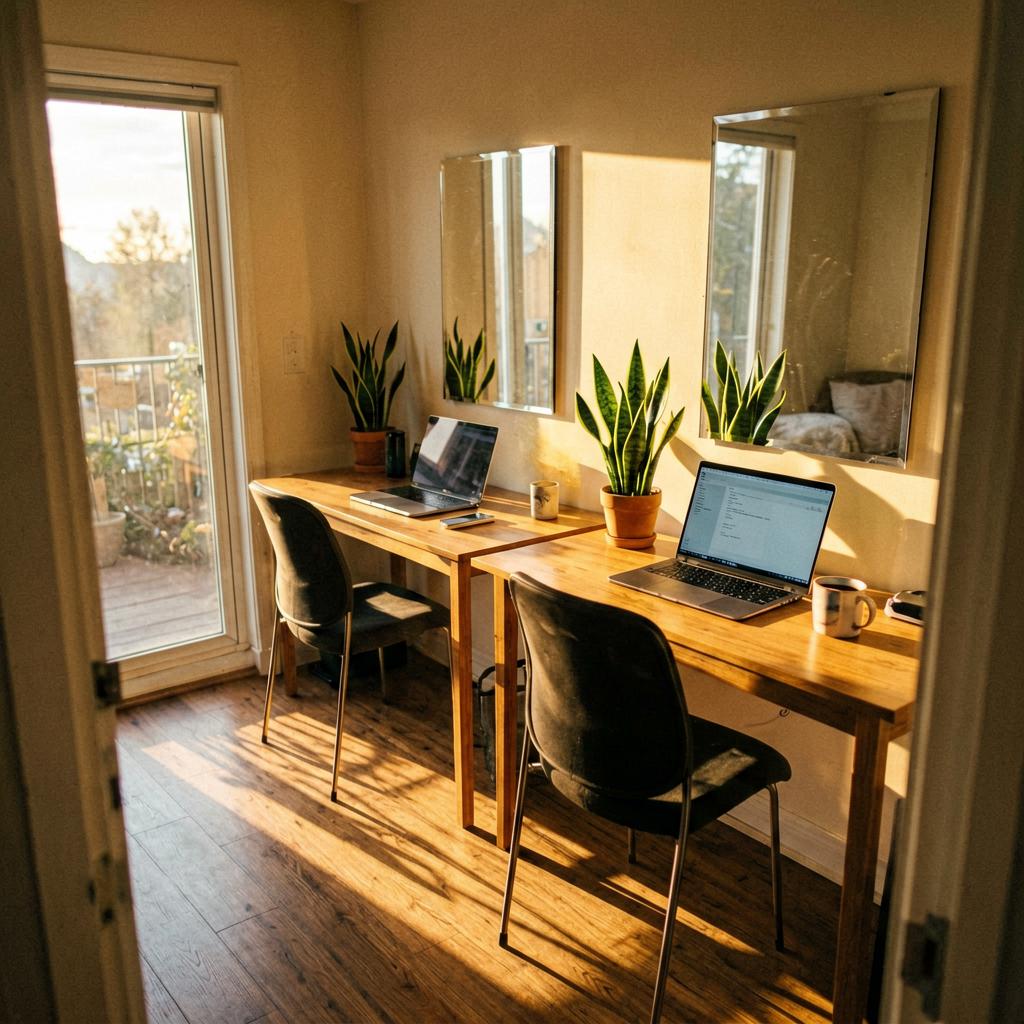
Location
Portland, United States
Property Type
Apartment
Room
Home Office
Direction
West
The Problem
For six months, my wife and I couldn't have a conversation without it turning into a fight. It started small — who left the dishes, who forgot to take out the trash — but escalated fast. I'd come home from work dreading the next argument. We both felt like we were walking on eggshells. We tried counseling, date nights, even a weekend away. Nothing stuck. The weird thing? The fights always happened in our home office, never in the living room or kitchen.
What They Tried
A friend who's a space consultant came over for coffee. She walked through our apartment, stopped in the home office, and said, 'You need to move her desk.' My wife's desk faced the wall, with her back to the door. Every time I walked in, she'd spin around, startled. My desk faced hers at an angle. The consultant suggested rotating my wife's desk 90 degrees so she faced the door, and moving mine against the opposite wall. We did it that weekend — a Saturday afternoon, took about an hour.
What Happened
It wasn't instant, but within a week, the atmosphere shifted. My wife stopped flinching when I entered the room. She could see me coming, and she'd look up, smile, say hi. We started having normal conversations in there — about our days, plans for the weekend. The arguments didn't disappear overnight, but the tension did. Three weeks later, I realized we hadn't had a real fight in two weeks. Now, six months on, the home office is our calmest room. I still don't fully understand why it worked, but I'm not questioning it.
Spatial Orientation
| Bagua Sector | 兑 ☱ · Dui |
|---|---|
| Direction | West |
| Element | metal |
What works best here
Dui (7) · Metal. West should be lower and more open than East for left-right equilibrium.
Place: low cabinets, metal decor (brass, copper, steel), round shapes, white and grey tones.
Recommended crystal
Clear Quartz or Selenite — placed on a low console or side table in the west
Round shapes and metallic finishes feel especially at home on this side of the room
Source Analysis
1. The Original Principle
Original Chinese
癸为罚狱、勾陈,次子妇命座,犯之害命坐人,口舌斗讼等灾。[七月西壬日修,三月亦通,宫羽姓不宜三月,七月即吉日]
English Translation
An ancient text on dwellings notes that certain positions in a home, when disturbed, can provoke conflict and legal disputes among occupants. The area associated with the second son's wife is particularly sensitive. Moving furniture or renovating in this area can either trigger or resolve tension, depending on timing and placement.
2. About the Source
宅经 by Attributed to the Yellow Emperor · China · Tang Dynasty (618–907 CE), based on earlier traditions
The Classic of Dwellings is one of the earliest surviving Chinese texts dedicated entirely to residential architecture. It presents a holistic view of the home as a living organism — comparing the house to a body with its own anatomy of walls, doors, rooms, and courtyards. Its core teaching is that a well-arranged home supports the health and fortune of its inhabitants as naturally as good soil supports healthy plants.
3. How This Principle Applies to This Case
This case illustrates a classic spatial psychology principle: sightlines and personal territory. When the wife's desk faced the wall with her back to the door, she was in a constant state of startle reflex — a physiological response that primes the body for fight-or-flight. Every time her husband entered, she experienced a micro-dose of alarm, which primed her for defensive, argumentative responses. By rotating the desk so she faced the door, she regained visual control of her environment, reducing that automatic stress response. Modern environmental psychology confirms that people in open sightline positions report lower cortisol levels and fewer conflict episodes. The specific direction (West, according to the source) may have amplified the effect, but the core mechanism is universal: when we feel seen and in control of our space, we argue less.
Bring the Purest Energy Into Your Home
Sourced from altitudes above 4,000 meters in the Himalayan range — the highest place on Earth and the closest to the sun. These crystals formed over millions of years in some of the planet's most pristine conditions, untouched by industrial pollution. Each piece carries the raw, unfiltered energy of the mountains. Whether placed on a nightstand, a desk, or a meditation corner, they serve as a quiet anchor — a daily reminder to pause, breathe, and reconnect.
Explore the HIMA ALAÏA collection →Case source
Domicile Design
30+ years of high-end interior design in Minneapolis. Certified Feng Shui master and Diamond Dowser, specializing in geopathic stress detection and spatial environmental science.