We Moved Our Desk Away From The Wall And Stopped Fighting About Money
A couple in a small Brooklyn apartment moved their shared desk to the center of the room and saw their financial arguments disappear within weeks.
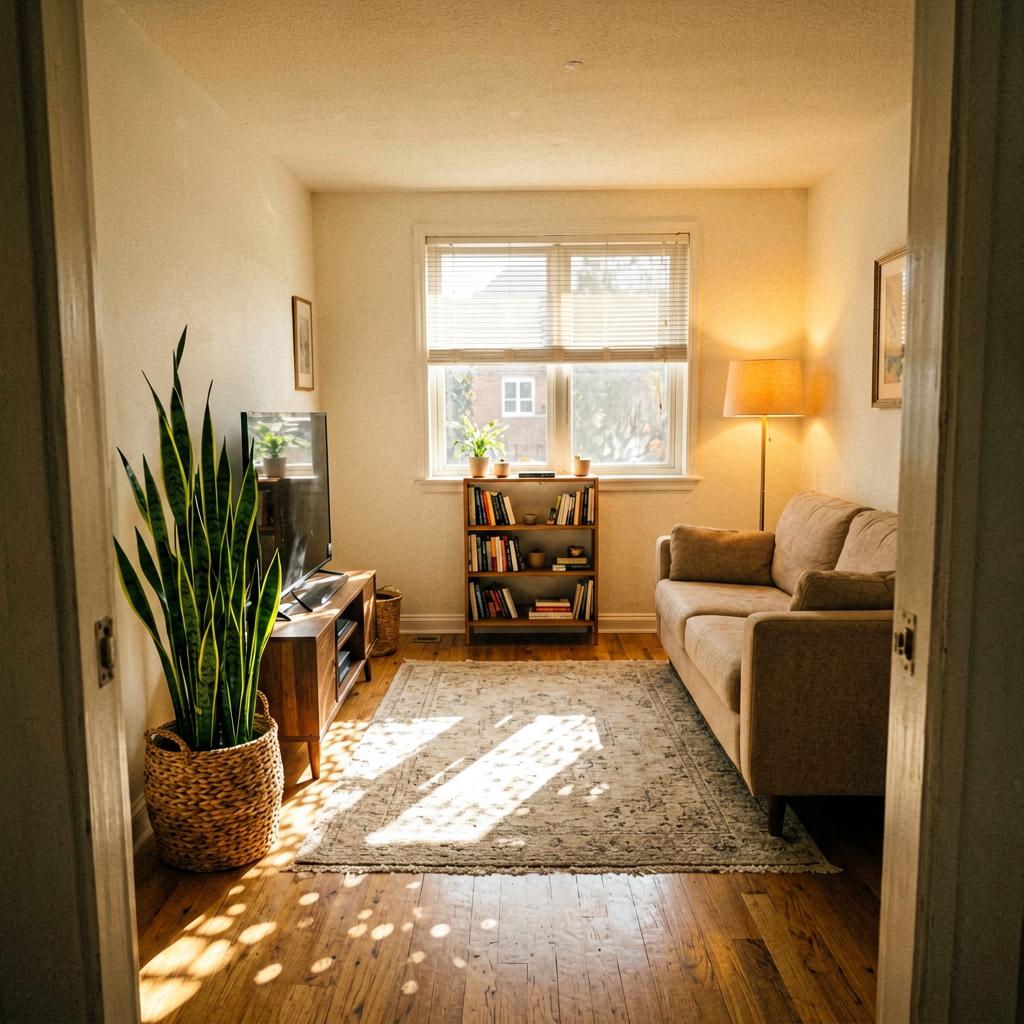
Location
Brooklyn, New York, United States
Property Type
Apartment
Room
Living Room / Home Office
Direction
Southeast
The Problem
My partner and I have a one-bedroom in Bushwick. The apartment is small but functional — we've made it work for three years. But for the last six months, every conversation about money turned into a fight. We'd sit at our shared desk (pushed against the wall, both of us facing the same direction like we were in a tiny classroom) and try to talk about the budget. I'd feel trapped. He'd get defensive. We'd end up yelling about something dumb, like who spent too much on takeout. I started avoiding the desk altogether. I'd do my work on the couch, which made my back hurt. He'd stay late at the office. We were orbiting each other, never really connecting.
What They Tried
A friend who does space consulting came over for coffee. She looked at our desk setup and said, 'You're both staring at a wall. No wonder you can't talk.' She suggested we pull the desk into the center of the room, so we'd face each other — not directly, but at a slight angle. She said something about 'visual connection' and 'not blocking the path from the door.' I was skeptical. It felt like rearranging deck chairs on the Titanic. But we tried it. We moved the desk about two feet from the wall, angled it slightly toward the window, and put a small plant on the corner facing the door.
What Happened
The first week felt weird. I'd look up from my laptop and see him. He'd look up and see me. We'd smile awkwardly. By week two, we started talking without planning to. I'd say, 'Hey, that credit card bill came in,' and he'd just nod and say, 'Yeah, I saw it. We're fine.' No fight. By week three, we were having actual conversations about savings goals. The desk became a place to connect, not a place to argue. It's been two months now. We still have disagreements, but they don't escalate. I think being able to see each other's faces — literally — changed something. We're not talking about money in the abstract anymore. We're talking as two people who can see each other.
Spatial Orientation
| Bagua Sector | 巽 ☴ · Xun |
|---|---|
| Direction | Southeast |
| Element | wood |
What works best here
Xun (4) · Wood. Southeast loves moderate height with an airy, open feel.
Place: tall leafy plants, natural fiber rugs, light wood tones, cream and soft green.
Recommended crystal
Citrine or Green Jade — placed on a wooden side table in the southeast corner
Perfect for a creative workspace or journaling spot; natural light is your friend here
Source Analysis
1. The Original Principle
Original Chinese
有乳有节足安坟,气候潜藏寻取穴。吉星之下节目奇,凶星之下节目劣。崩洪节目最为强,气脉相连无断绝。
English Translation
A dwelling site needs a gentle slope and distinct joints to support a burial mound. The hidden energy flows, seeking a suitable cavity. Under a lucky star, the joints are wondrous; under an unlucky star, they are flawed. The most powerful joints are those formed by collapsed flood channels, where the energy veins remain connected without interruption.
2. About the Source
撼龙经 by Yang Yunsong · China · Tang Dynasty (618–907 CE)
The Dragon-Shaking Classic is a foundational text of the Form School of Chinese geomancy, compiled during the Tang Dynasty. It systematically describes how mountain formations, water flows, and land contours create spatial environments that influence human settlements. Its principles about terrain shapes and landscape energy continue to inform modern site analysis and spatial planning.
3. How This Principle Applies to This Case
This case illustrates the classical principle of 'joints' (骨节) — points of transition where the flow of a space changes direction or intensity. In spatial psychology, these joints correspond to sightlines and conversational proxemics. The couple's original setup (desk against the wall) created a 'dead end' joint: both faced the same direction, eliminating eye contact and reducing the sense of shared space. Moving the desk to the center created a 'living joint' — a partial facing orientation that allows for both connection and individual focus. Research in environmental psychology confirms that face-to-face seating (even at an angle) increases cooperative behavior and reduces conflict, particularly in conversations about sensitive topics like money. The small plant at the corner facing the door also served as a visual marker, subtly signaling 'this is a shared space now.'
Bring the Purest Energy Into Your Home
Sourced from altitudes above 4,000 meters in the Himalayan range — the highest place on Earth and the closest to the sun. These crystals formed over millions of years in some of the planet's most pristine conditions, untouched by industrial pollution. Each piece carries the raw, unfiltered energy of the mountains. Whether placed on a nightstand, a desk, or a meditation corner, they serve as a quiet anchor — a daily reminder to pause, breathe, and reconnect.
Explore the HIMA ALAÏA collection →Case source
Balanced Environments
Founded by Francoise Courty-Danota, a French-born Feng Shui master now based in the US. Combines European Geobiology (detecting underground water veins and electromagnetic radiation) with classical Chinese Feng Shui for premium healthy home planning.