Why I Couldn't Focus at My Home Office Desk — Until I Turned It Around
A freelance writer shares how repositioning her desk to face the door transformed her focus and reduced anxiety during work hours.
Location
Portland, United States
Property Type
Apartment
Room
Home Office
Direction
Southwest
The Problem
For six months, I couldn't concentrate. I'd sit down at my desk in the home office — a small room off the living room — and my brain would feel like static. I'd open a document, type three sentences, then check my phone. Or get up for water. Or just stare at the wall. I wasn't lazy; I was jumpy. Every time someone walked past the door (which was right behind my chair), I'd flinch. I'd spin around to see who it was — my partner, the cat, a delivery. My heart would race. I couldn't settle. I tried noise-canceling headphones, white noise apps, even a weighted blanket over my lap. Nothing helped. My productivity tanked. I was missing deadlines. I felt like a failure.
What They Tried
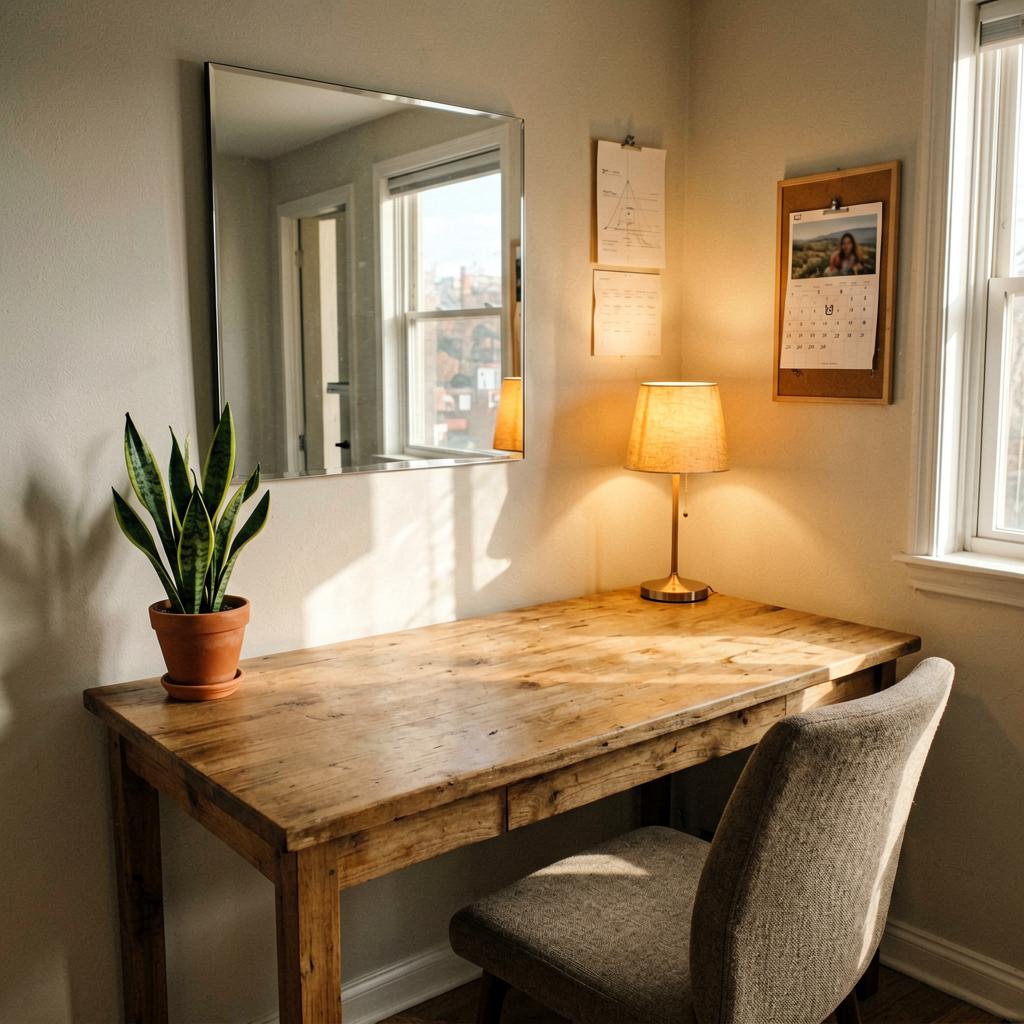
A friend who works in space planning came over one afternoon. She stood in the doorway of my office, looked around, and said, 'You need to see the door.' I laughed — it sounded like some weird life hack. But she explained it practically: 'Your brain is on high alert because you can't see who's coming. It's not mystical; it's biology.' So we moved the desk. We slid it from against the wall to a spot where, when I sit, I can see the door in my peripheral vision. It meant facing away from the window, which I was sad about. But the desk now sits diagonally, with the door about 45 degrees to my left. I also added a small mirror on the wall to my right, which reflects the door — a trick she suggested so I'd have full visual coverage without craning my neck.
What Happened
The difference was immediate — and I don't say that lightly. On the first day, I sat down and didn't flinch once. I typed for three hours straight. I could hear my partner walk past, but I wasn't startled; I just knew someone was there. The anxiety faded within a week. My focus improved to the point where I'm now finishing projects ahead of deadlines. I still face away from the window, and honestly, I miss the natural light sometimes. But I've added a warm desk lamp and a small plant, and the trade-off is worth it. I'm not jumpy anymore. I'm not scared of my own doorway. It sounds like such a small change, but it reshaped how I feel in that room.
Spatial Orientation
| Bagua Sector | 坤 ☷ · Kun |
|---|---|
| Direction | Southwest |
| Element | earth |
What works best here
Kun (2) · Earth. Southwest favors grounded, low-profile arrangements that feel intimate.
Place: low cozy seating, plush textiles, warm indirect lamps, soft pink and terracotta.
Recommended crystal
Rose Quartz or Pink Tourmaline — placed on a nightstand or low shelf in the southwest
This area supports comfort and connection — a perfect spot for a reading chair or small sofa
Source Analysis
1. The Original Principle
Original Text
Lo primero y principal es ver la puerta desde el escritorio, ya sea directamente o a través de un espejo.
English Translation
A Western adaptation of spatial awareness principles notes that the desk should be positioned so the door is visible, either directly or via a mirror. This reduces startle responses and supports sustained attention.
2. About the Source
Feng shui para Occidente by Terah Kathryn Collins · United States · 1995
Feng Shui for the West is a practical guide that adapts classical Chinese spatial principles for modern Western homes and lifestyles. Written by one of the first American authors to bring Feng Shui to a mainstream English-speaking audience, the book translates ancient Bagua concepts into actionable room-by-room advice using familiar Western design language and contemporary case examples.
3. How This Principle Applies to This Case
This case illustrates a basic principle of environmental psychology: the startle reflex. When our back is to a door, our brain remains partially vigilant, scanning for threats we can't see. By repositioning the desk to face the door, the homeowner reduced her brain's 'hypervigilance' state. The mirror extension provided full visual coverage without turning. Modern neuroscience confirms that visual access to entry points reduces cortisol levels and improves cognitive performance. The change was practical, not mystical — a simple spatial adjustment that addressed a biological need for safety.
Bring the Purest Energy Into Your Home
Sourced from altitudes above 4,000 meters in the Himalayan range — the highest place on Earth and the closest to the sun. These crystals formed over millions of years in some of the planet's most pristine conditions, untouched by industrial pollution. Each piece carries the raw, unfiltered energy of the mountains. Whether placed on a nightstand, a desk, or a meditation corner, they serve as a quiet anchor — a daily reminder to pause, breathe, and reconnect.
Explore the HIMA ALAÏA collection →Case source
International Feng Shui School
One of America's most prominent Feng Shui training and consulting organizations, headquartered in California. Offers full-spectrum solutions from commercial Feng Shui surveying to residential energy layout.