Why I Moved My Home Office Desk Out of the Southeast Corner — And Stopped Feeling So Stuck
Location
Portland, Oregon, United States
Property Type
Apartment
Room
Home Office
Direction
Northwest
The Problem
I'm a designer, so I thought I had the whole room-layout thing figured out. But my home office felt cramped and restless — I'd sit down to work and immediately want to get up. I'd stare at the wall, check my phone, reorganize my pens. It wasn't burnout; it was the room itself.
What They Tried
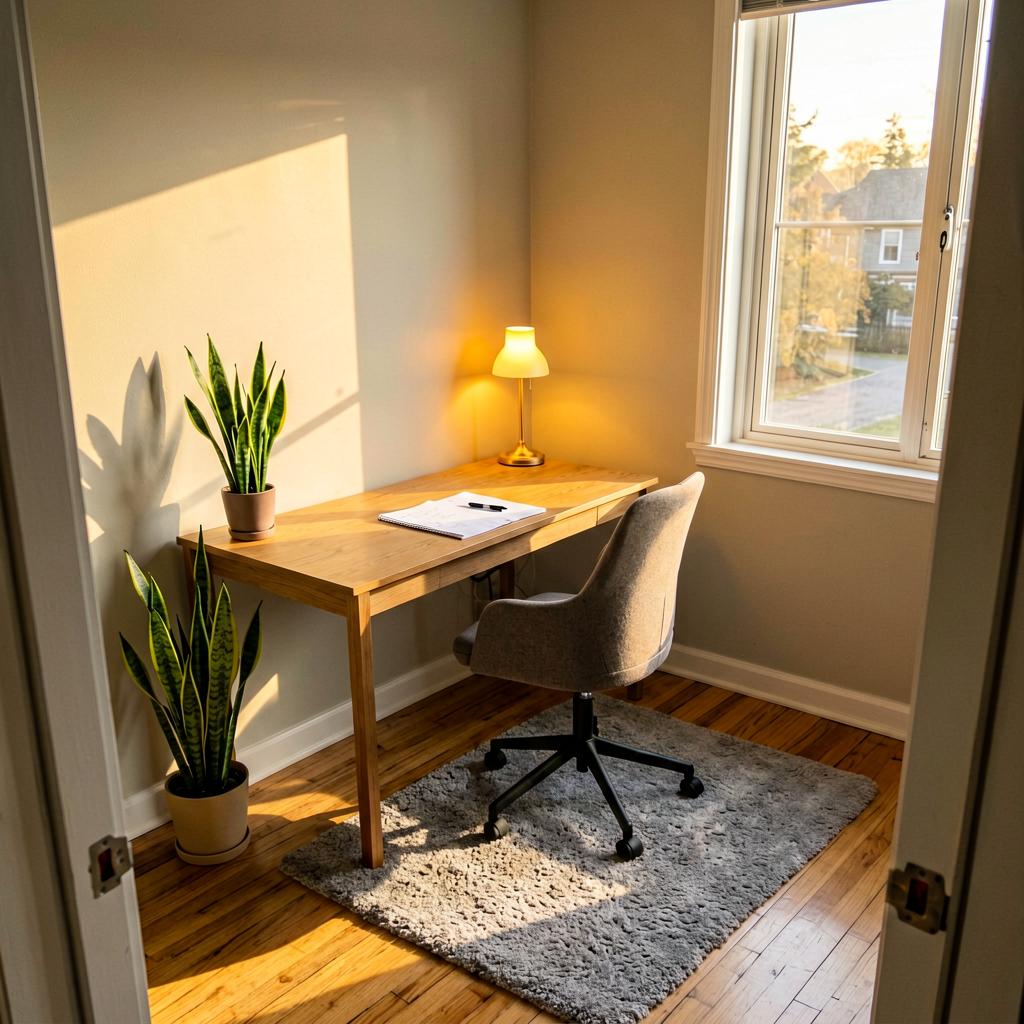
I moved the desk from the southeast corner to the northwest wall. That was it. Same chair, same monitor, same coffee mug. The only change was the desk's position in the room.
What Happened
The first day, I sat down at 9am and didn't look at my phone until noon. The room finally felt like it was working with me instead of against me. My focus didn't magically become perfect, but the urge to flee the room was gone.
Spatial Orientation
| Bagua Sector | 乾 ☰ · Qian |
|---|---|
| Direction | Northwest |
| Element | metal |
What works best here
Qian (6) · Metal. Northwest should feel open, organized, and uncluttered.
Place: clean-lined storage, metal objects, minimal decor, organized shelving.
Recommended crystal
Clear Quartz or Hematite — placed on a desk or shelf where it stays dust-free and visible
This sector supports clarity and order — keep it clean and intentional, not crowded
Source Analysis
1. The Original Principle
Original Chinese
乾兑艮坤,四卦相生相助……坎离震巽,四卦也是相生相助……但是,在乾坤艮兑四卦与坎离震巽四卦,两组之间,却互相克伐,互相敌对。
English Translation
The classical principle groups the eight trigrams into two supportive sets of four. The Qian-Dui-Gen-Kun set harmonizes internally; so does Kan-Li-Zhen-Xun. Between the two sets, the energies clash, so a room's orientation and its main activity areas should belong to the same set.
2. About the Source
八宅明镜上卷 by Yang Yunsong (attributed) · China · Qing Dynasty (1644–1912 CE)
The Eight Mansions Bright Mirror is one of the most influential classical Chinese texts on residential architecture. For over three centuries, it has served as a foundational reference for understanding how the layout and orientation of living spaces affect the wellbeing of their inhabitants, focusing on how living spaces can be arranged to support health, relationships, and prosperity.
3. How This Principle Applies to This Case
This case illustrates a core spatial-logic principle: a room's orientation and its primary activity zone need to be internally consistent. The homeowner's desk originally sat in a corner that conflicted with the room's overall alignment, creating a subtle sense of friction. Modern environmental psychology supports this: when our immediate surroundings are congruent with our intended activity, cognitive load drops and focus improves. Moving the desk to a matching wall removed that subconscious dissonance, making the space feel 'right' for working. It's not magic — it's about aligning the physical layout with the function.
Bring the Purest Energy Into Your Home
Sourced from altitudes above 4,000 meters in the Himalayan range — the highest place on Earth and the closest to the sun. These crystals formed over millions of years in some of the planet's most pristine conditions, untouched by industrial pollution. Each piece carries the raw, unfiltered energy of the mountains. Whether placed on a nightstand, a desk, or a meditation corner, they serve as a quiet anchor — a daily reminder to pause, breathe, and reconnect.
Explore the HIMA ALAÏA collection →Related Elements
Case source
Feng Shui Joan's Way
Connecticut-based Feng Shui consultant. Specializes in Western Bagua system for small and medium business Feng Shui layouts to enhance wealth and team cohesion.