Why I Turned My Desk 90 Degrees: The Home Office Rearrangement That Finally Made Me Focus
I moved my desk to face the window in my home office, and the difference was immediate. Here's how a simple rotation changed my focus and my workday.
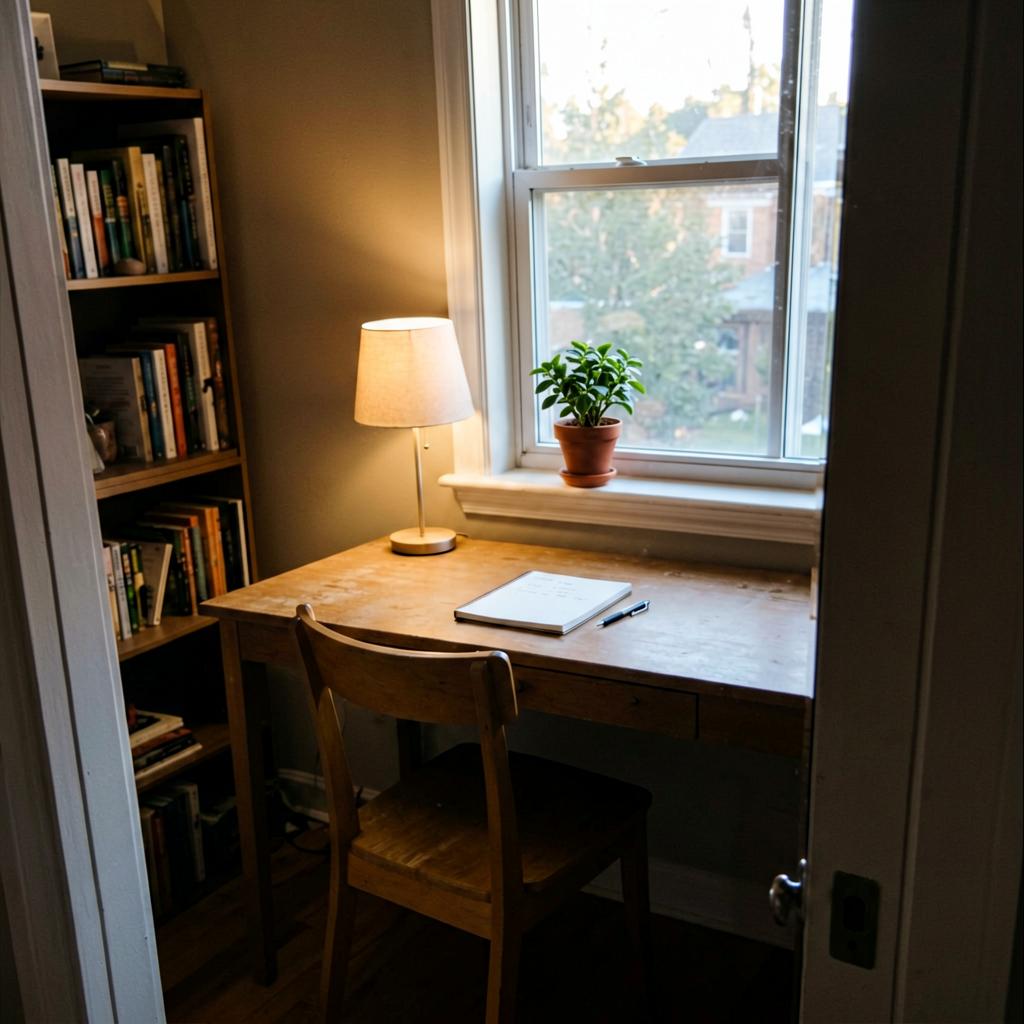
Location
Portland, Oregon, United States
Property Type
Apartment
Room
Home Office
Direction
East
The Problem
I couldn't focus. Working from home three days a week, my home office felt like a punishment. Every email took twice as long. I'd stare at the wall, then at my phone, then back at the wall. The room was fine—a typical 10x12 spare bedroom with a desk against the wall facing the door. Nothing obviously wrong. Yet I was constantly tired, distracted, and honestly a little anxious about how unproductive I'd become.
What They Tried
I swapped the desk and the bookshelf. The desk now sits against the window wall, facing the room. So I'm looking at the door and the window, not at a blank wall. It took about twenty minutes to move everything. I didn't buy anything new—just shifted the furniture.
What Happened
The first day felt different. I wasn't staring at the wall anymore. I could see the window, the light, and the room beyond. I noticed I was sitting up straighter, too. By the end of the week, I was finishing tasks without that constant urge to check my phone. My husband even commented that I seemed less grumpy after calls. It's not a miracle—I still have rough days—but the room no longer feels like a trap. It feels like a place to work.
Spatial Orientation
| Bagua Sector | 震 ☳ · Zhen |
|---|---|
| Direction | East |
| Element | wood |
What works best here
Zhen (3) · Wood. East should be the tallest area of the room when possible.
Place: tall plants (especially bamboo or fiddle-leaf fig), wooden furniture, green accents.
Recommended crystal
Green Aventurine or Moss Agate — placed near a window or on a plant shelf in the east
This is the growth sector — plants thrive here and vertical elements feel natural
Source Analysis
1. The Original Principle
Original Chinese
天关龙坐天汉星,气从右耳须细寻。微加天绒辅龙行,水朝局锁人财盛。
English Translation
A classical text on site selection describes a dragon's energy arriving from the right ear, with a subtle star guiding the path. It suggests that when water faces the site and the enclosure holds it, people prosper. In practical terms, it points to how orientation and sightlines shape a place's vitality.
2. About the Source
催官篇卷之二 评穴章 by Lai Buyi · China · Song Dynasty (960–1279 CE)
The Promotion Classic is a Song Dynasty text focused on how the spatial arrangement of landforms and water features around a dwelling can influence the career advancement and social recognition of its occupants. It combines Form School landscape analysis with the Bagua directional framework, offering practical guidance on site evaluation that has been consulted by scholars and officials for centuries.
3. How This Principle Applies to This Case
The classical principle emphasizes how subtle orientation details—like the path of arrival and what faces the viewer—affect a space's character. In this case, the desk's rotation changed the user's sightline from a blank wall to a window and door. Modern environmental psychology supports this: visual access to natural light and movement reduces stress and improves attention. The 'right ear' metaphor translates here to the desk's new position relative to the door, allowing a broader awareness of the room. The result aligns with the text's observation that when a space 'holds' the occupant's attention, productivity follows.
Bring the Purest Energy Into Your Home
Sourced from altitudes above 4,000 meters in the Himalayan range — the highest place on Earth and the closest to the sun. These crystals formed over millions of years in some of the planet's most pristine conditions, untouched by industrial pollution. Each piece carries the raw, unfiltered energy of the mountains. Whether placed on a nightstand, a desk, or a meditation corner, they serve as a quiet anchor — a daily reminder to pause, breathe, and reconnect.
Explore the HIMA ALAÏA collection →Case source
Anjie Cho Architect & Holistic Spaces
NYC-based architect and BTB Feng Shui master. Co-founder of Mindful Design Feng Shui School. Blends modern interior design with classical BTB Feng Shui. Author of multiple Feng Shui books.