Why My Home Office Still Felt Off Even After I Added That Big Bookshelf (And What Finally Fixed It)
A remote worker tries to fix a chronically uncomfortable home office by adding storage, only to realize the real problem was a missing visual anchor on the left side of the room.
Location
Portland, Oregon, United States
Property Type
Apartment
Room
Home Office
Direction
East
The Problem
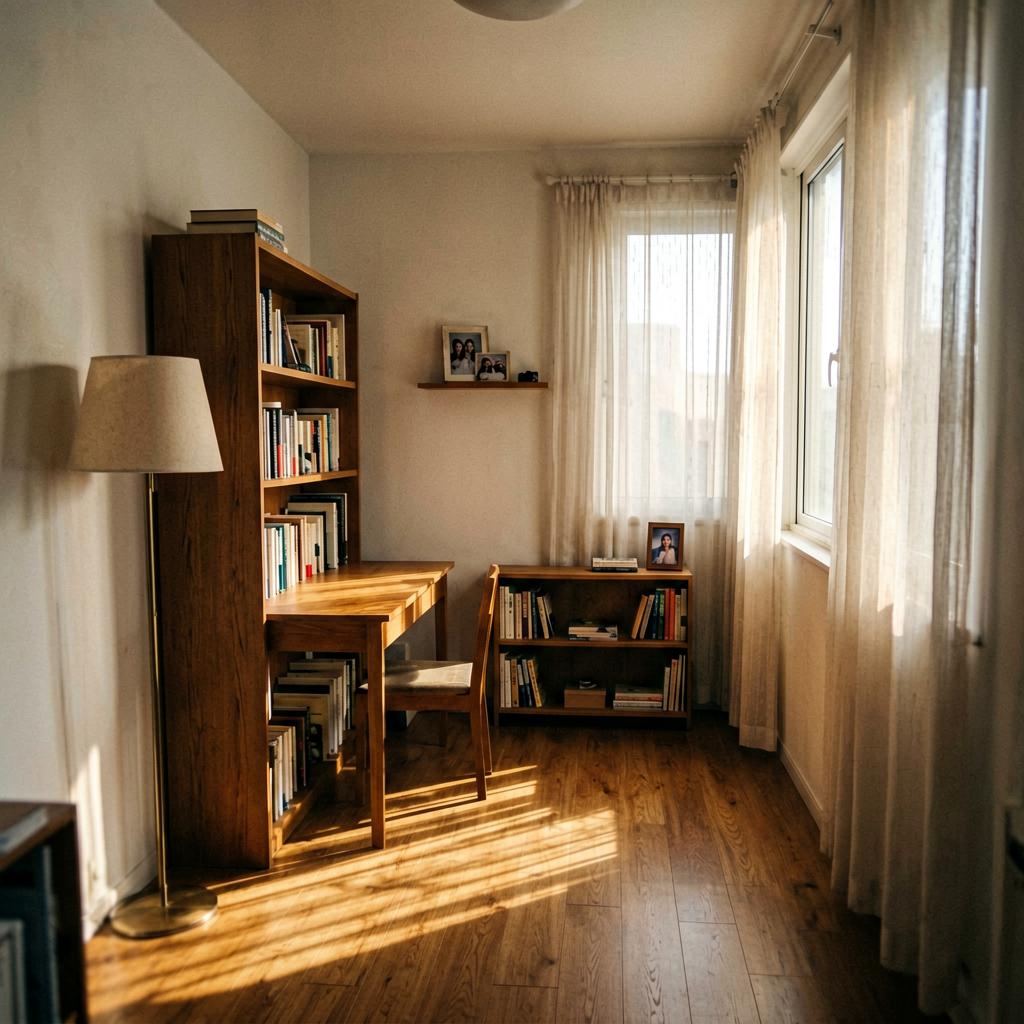
I work from home three days a week, and my home office has always felt… wrong. Not messy, not dark — just unsettled. I’d fidget in my chair, lose focus after an hour, and feel like I couldn’t settle into any task. The room is a narrow rectangle, about 10 by 14 feet, with one window on the right wall. My desk faces the long wall opposite the door. On the right side of the desk, I had a tall bookshelf crammed with binders and reference books. The left side was just empty wall — a blank white expanse. I thought the problem was clutter, so I added more shelving (on the right, naturally), bought a plant, even a rug. Nothing helped. I still felt like I was leaning into a void every time I sat down.
What They Tried
A friend who’s a space consultant came over. She stood in the doorway, looked around, and said, 'You have everything on the right side of the room. Your eye goes there and then… nothing. It’s like a seesaw with only one person sitting on it.' Her fix was simple: swap my desk to the left side of the room, so the window is on my left, and put a low, wide shelf on the wall opposite the door (which was previously empty). Then, she said, move the tall bookshelf to the left of the desk, creating a visual balance. I was skeptical — it was a lot of furniture moving — but I tried it. I also added a floor lamp on the left side, just to give that corner some weight.
What Happened
The difference was immediate and weirdly physical. When I sit down now, my eyes scan the room evenly. I don’t feel that subtle lean to the right. My focus is better — I can work for two hours straight without drifting. I also noticed I don’t get that vague headache I used to get by 3 PM. The room feels settled. My friend explained that our brains crave visual balance, and when one side of a room is heavy with objects and the other is bare, it creates a subconscious unease. I didn’t need more stuff; I needed the stuff I already had to be distributed properly.
Spatial Orientation
| Bagua Sector | 震 ☳ · Zhen |
|---|---|
| Direction | East |
| Element | wood |
What works best here
Zhen (3) · Wood. East should be the tallest area of the room when possible.
Place: tall plants (especially bamboo or fiddle-leaf fig), wooden furniture, green accents.
Recommended crystal
Green Aventurine or Moss Agate — placed near a window or on a plant shelf in the east
This is the growth sector — plants thrive here and vertical elements feel natural
Source Analysis
1. The Original Principle
Original Chinese
左空缺而右重抱者,徒劳。
English Translation
An old text about mountain forms notes that when the left side of a valley is open but the right side has multiple ridges wrapping around protectively, the effort is wasted. The protection lacks balance, and the space never feels secure.
2. About the Source
雪心赋 论水口 by Bu Yingtian · China · Tang Dynasty (618–907 CE)
The Snow Heart Rhapsody is a poetic yet rigorously analytical classical text on landscape assessment. Written in rhymed prose, it covers mountain forms, water patterns, terrain energy, and site selection with remarkable literary elegance. Its observations about how land contours create sheltered, comfortable settings for human habitation remain relevant to modern site planning and environmental psychology.
3. How This Principle Applies to This Case
This case illustrates a principle about spatial balance: when one side of a room is visually 'heavy' with objects (bookshelves, furniture, lamps) and the opposite side is bare, the brain registers an asymmetry that can create a subtle, persistent unease. The classical observation about mountain forms applies here: a single-sided visual weight, no matter how substantial, cannot compensate for an empty counterpart. Modern environmental psychology supports this — humans have a built-in preference for symmetrical, balanced spaces, which correlate with feelings of stability and comfort. The fix wasn't about adding more; it was about redistributing existing elements to create equal visual weight on both sides of the room's central axis.
Bring the Purest Energy Into Your Home
Sourced from altitudes above 4,000 meters in the Himalayan range — the highest place on Earth and the closest to the sun. These crystals formed over millions of years in some of the planet's most pristine conditions, untouched by industrial pollution. Each piece carries the raw, unfiltered energy of the mountains. Whether placed on a nightstand, a desk, or a meditation corner, they serve as a quiet anchor — a daily reminder to pause, breathe, and reconnect.
Explore the HIMA ALAÏA collection →Related Elements
Case source
Pure Living with Lisa Morton
15 years of architectural design background, transformed into advanced space decluttering and Interior Alignment mastery. Specializes in residential energy balancing.