Why My Staircase Art Was Making Every Visit Feel Like a Downer — and the One Fix That Changed It
A homeowner noticed guests always seemed tense in her two-story entryway. The culprit? A staircase gallery hung in descending order. Aligning the frames at one height (and swapping in brighter art) turned the whole vibe around.
Location
Portland, OR, United States
Property Type
House
Room
Entryway
Direction
Southeast
The Problem
Every time someone walked into my house, I could feel the energy drop. It wasn't just me—guests would hover awkwardly in the entryway, cross their arms, and rush to the living room. I blamed the dark paint, the narrow hall, even the lack of a console table. But deep down, I knew it was the staircase. I'd hung a collection of small prints in a descending line, from the top of the stairs all the way down to the first floor. It looked intentional, artsy even. But something felt… off.
What They Tried
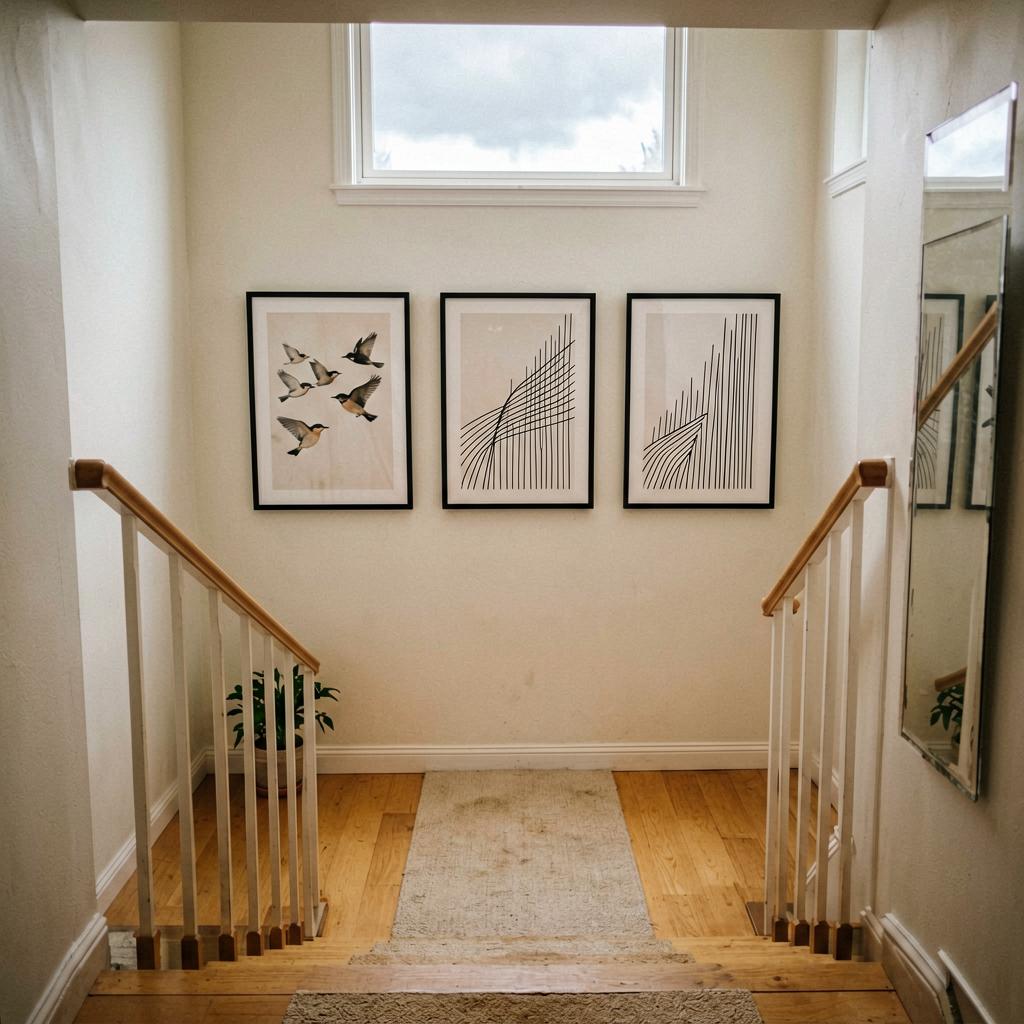
A friend who does interior staging came over and immediately pointed to the stairs. 'Your art is leading the eye down,' she said. 'It's like the whole room is sliding.' We took everything down. I had a few bright, optimistic pieces—a watercolor of birds taking flight, an abstract with rising diagonal lines. We measured the height, aligned all the frames at the exact same level, and hung them in a clean horizontal row. It took maybe an hour. No new frame, no new paint.
What Happened
The difference was subtle but real. The entryway felt… taller. The eye stopped dropping to the floor; instead, it moved up and across. Guests now pause at the stairs, look at the art, even comment on it. My own mood when I come home shifted—I'm less irritable, more settled. I didn't expect a wall rearrangement to change the feel of my whole house, but it did. It's not magic; it's just that the room finally stops pulling you down.
Spatial Orientation
| Bagua Sector | 巽 ☴ · Xun |
|---|---|
| Direction | Southeast |
| Element | wood |
What works best here
Xun (4) · Wood. Southeast loves moderate height with an airy, open feel.
Place: tall leafy plants, natural fiber rugs, light wood tones, cream and soft green.
Recommended crystal
Citrine or Green Jade — placed on a wooden side table in the southeast corner
Perfect for a creative workspace or journaling spot; natural light is your friend here
Source Analysis
1. The Original Principle
Original Text
Asegúrese de no estar acentuando la pendiente de la catarata, colgando en el hueco de la escalera cuadros en un orden descendente. Si quiere utilizarlos para canalizar de nuevo el chi, póngalos todos a la misma altura, lo que creará una fuerte línea horizontal que mantendrá el chi elevado. Elija cuadros cuyos temas sean luminosos y optimistas, lo que creará movimiento escaleras arriba: pájaros en pleno vuelo o de una composición abstracta de líneas ascendentes.
English Translation
If you hang pictures in a descending order on a stairwell wall, you emphasize the downward slope of the staircase, dragging the eye—and the energy—down. Instead, hang all frames at the same height to create a strong horizontal line that keeps the energy lifted. Choose bright, optimistic subjects—birds in flight or abstract upward lines—to encourage movement up the stairs.
2. About the Source
Feng shui para Occidente by Terah Kathryn Collins · United States · 1995
Feng Shui for the West is a practical guide that adapts classical Chinese spatial principles for modern Western homes and lifestyles. Written by one of the first American authors to bring Feng Shui to a mainstream English-speaking audience, the book translates ancient Bagua concepts into actionable room-by-room advice using familiar Western design language and contemporary case examples.
3. How This Principle Applies to This Case
The principle here is about visual weight and eye movement. When art is hung in a descending line, it creates a strong diagonal that leads the gaze downward, reinforcing the natural pull of gravity in a stairwell. This can make a space feel heavier and more fatiguing. By aligning frames at a single height, the eye is given a stable horizontal line to rest on, which supports a sense of balance and lift. The choice of bright, upward-oriented imagery adds a subtle psychological cue of optimism and aspiration. Modern environmental psychology supports this: our perception of a room is heavily influenced by line and direction, and downward-leading lines can trigger a low-level stress response. The simple act of rehanging art is a low-cost, high-impact way to alter the felt experience of a space.
Bring the Purest Energy Into Your Home
Sourced from altitudes above 4,000 meters in the Himalayan range — the highest place on Earth and the closest to the sun. These crystals formed over millions of years in some of the planet's most pristine conditions, untouched by industrial pollution. Each piece carries the raw, unfiltered energy of the mountains. Whether placed on a nightstand, a desk, or a meditation corner, they serve as a quiet anchor — a daily reminder to pause, breathe, and reconnect.
Explore the HIMA ALAÏA collection →Case source
Clear Space For You
California-based Chinese-American Feng Shui and energy organization expert. Proficient in both Eastern and Western Feng Shui schools. Specializes in resolving family tension, sleep issues, and wealth stagnation through spatial dynamics.