Why We Moved Our Home Office to the Back Room and Finally Stopped Arguing About Money
A couple living in a cramped San Francisco apartment discovers that moving their home office from the front room to a quieter back room changes their focus, their finances, and their relationship.
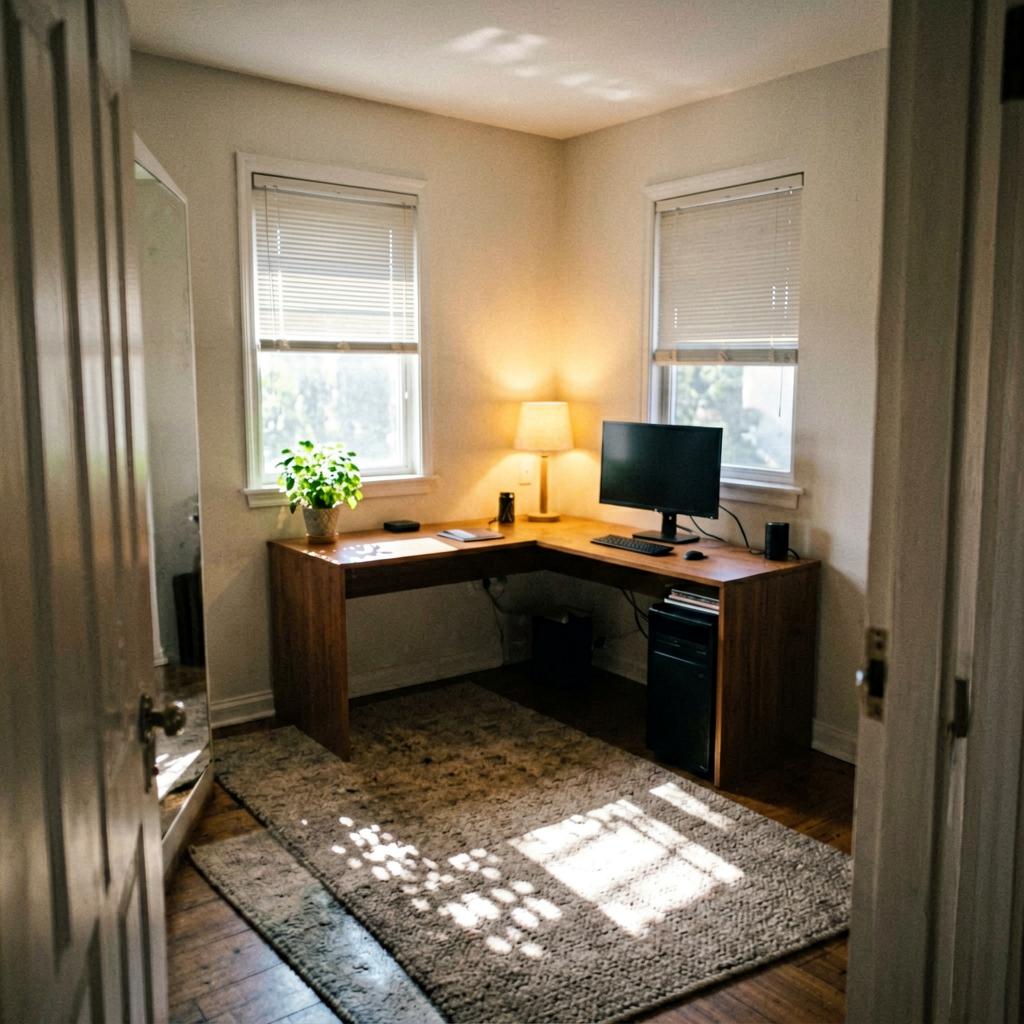
Location
San Francisco, United States
Property Type
Apartment
Room
Home Office
Direction
West
The Problem
My husband and I share a tiny one-bedroom apartment in the Mission District. For two years, our home office was set up in the living room—right next to the front door, facing a busy street. We both work from home, and the constant noise from delivery trucks and pedestrians was bad enough. But what really got to us was the layout: my desk was against the wall, feeling low and cramped, while his big L-shaped desk dominated the center of the room. I felt like I was in a hole; he felt like he was on display. We started snapping at each other over everything—who left a coffee mug out, who was on a call during the other's quiet time. By month three, we were barely speaking during work hours.
What They Tried
A friend who's a space consultant came over for coffee and saw the layout. She didn't say much, just asked: 'Which room feels stronger to you?' We both pointed to his desk. Then she said: 'What if the strong desk went in the strong room—the back bedroom—and your desk stayed here but turned to face the window?' We were skeptical, but desperate. So we moved his big desk into the spare bedroom (which barely fits a bed, but it's quiet and has a solid wall). I stayed in the living room but rotated my desk 90 degrees so I'm now facing our tiny balcony. The back room became 'his territory'—the stronger space—and the front room became 'mine'—lighter but lower-energy.
What Happened
Within a week, the arguing stopped. Not completely, but noticeably. I realized I'd been feeling overshadowed by his setup—like my work was secondary. Now, with my desk facing natural light and a view, I feel more in control. He claims he's getting more done because the back room is quieter and feels more 'serious.' Our bank account isn't suddenly overflowing, but we've both had better months at work. The weirdest part? We actually eat lunch together now, sitting on the floor of the living room, because the office isn't looming over us.
Spatial Orientation
| Bagua Sector | 兑 ☱ · Dui |
|---|---|
| Direction | West |
| Element | metal |
What works best here
Dui (7) · Metal. West should be lower and more open than East for left-right equilibrium.
Place: low cabinets, metal decor (brass, copper, steel), round shapes, white and grey tones.
Recommended crystal
Clear Quartz or Selenite — placed on a low console or side table in the west
Round shapes and metallic finishes feel especially at home on this side of the room
Source Analysis
1. The Original Principle
Original Chinese
龙星自有真峰应,雌山低弱雄山胜。
English Translation
In classical landscape analysis, a strong, dominant peak should be matched with a lower, supportive one. The taller feature commands the space, while the smaller one provides balance. This pairing creates a stable environment where each element has its proper role.
2. About the Source
撼龙经 by Yang Yunsong · China · Tang Dynasty (618–907 CE)
The Dragon-Shaking Classic is a foundational text of the Form School of Chinese geomancy, compiled during the Tang Dynasty. It systematically describes how mountain formations, water flows, and land contours create spatial environments that influence human settlements. Its principles about terrain shapes and landscape energy continue to inform modern site analysis and spatial planning.
3. How This Principle Applies to This Case
This case illustrates a spatial dynamic where one person's work area visually and audibly dominated the shared space, creating a subconscious hierarchy that led to friction. The solution—moving the stronger, larger desk to a physically contained room—mirrors the principle of pairing a dominant element with a supportive one. Psychologically, this reduced visual competition and gave each person a clear territory. The back room's solid walls and lower activity level provided the 'containment' needed for focused work, while the front room's openness suited lighter tasks. The result wasn't about mystical energy but about practical spatial boundaries that matched each person's work style.
Bring the Purest Energy Into Your Home
Sourced from altitudes above 4,000 meters in the Himalayan range — the highest place on Earth and the closest to the sun. These crystals formed over millions of years in some of the planet's most pristine conditions, untouched by industrial pollution. Each piece carries the raw, unfiltered energy of the mountains. Whether placed on a nightstand, a desk, or a meditation corner, they serve as a quiet anchor — a daily reminder to pause, breathe, and reconnect.
Explore the HIMA ALAÏA collection →Related Elements
Case source
Marie Burgos Design
High-profile luxury interior design firm with offices in NYC and LA. Founder Marie Burgos holds IFSG Red Ribbon Master certification. Deeply integrates modern French luxury design with Eastern Five Elements Feng Shui. Regularly featured in top design media.